

IHMC’s Running Man captures 2nd at DARPA robotics competition
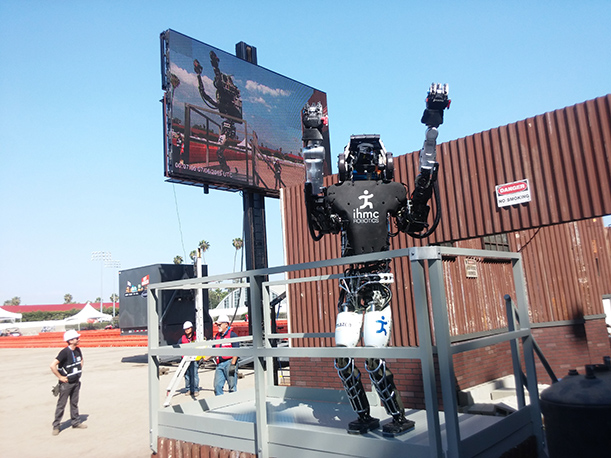
Published 9.10.15 Three years of almost non-stop work paid off Saturday when the Institute for Human and Machine Cognition placed second in a $3.5 million global robotics competition held in Pomona, Calif. Team IHMC’s semi-autonomous robot, nicknamed “Running Man,” on Saturday bested 21 other teams from around the world by driving a car, walking over debris, cutting a hole in a wall, turning a valve for a fire hose and performing other tasks — all with spotty communications between man and machine. The course simulated a disaster area in which humans could not safely operate. “I am incredibly proud of our robotics team,” said IHMC CEO/Director Ken Ford. “They did a amazing job finishing second overall and were first among the Atlas teams.” The competition, the third and final trial since 2013, was sponsored by DARPA, the Defense Advance Research Projects Agency. The first-place team, Team KAIST from South Korea, was awarded $2 million. It also completed all eight tasks, but did so six minutes faster than the IHMC robot. IHMC, which finished the course in just over 50 minutes Saturday, will bring home $1 million in prize money. A chimp-like robot from Carnegie Mellon University placed third. Only three… Read More
IHMC Robotics team heads to historic competition
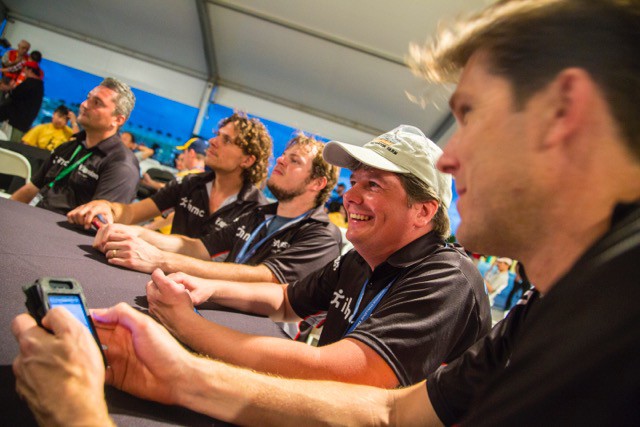
Published 9.10.15 The robotics team from the Florida Institute for Human and Machine Cognition (IHMC) leaves this weekend for what promises to be a historic milestone in the science of making machines move and think like humans. The DARPA Robotics Challenge Finals, to be held June 5-6 in Pomona, Calif., is sponsored by the Defense Advanced Research Projects Agency. It will test 25 teams from around the world in a challenge course designed to emulate a disaster area where humans could not safely go. IHMC’s team will be using the 6-foot-tall Atlas robot, built by Boston Dynamics but with the all-important controlling software designed by IHMC researchers. The winning team will bring home $2 million from DARPA, which will go to further robotics research. The second-place team will win $1 million. “It’s been a lot of non-stop work, but we’re ready to go,” said Doug Stephen, one of the computer scientists on the project for IHMC. For years, movies and television shows have portrayed bipedal robots as virtually flawless, fast-moving, self-thinking units. But the reality has lagged far behind that characterization. The DARPA Robotics Challenge was designed to push the science and engineering to the next level. And in recent… Read More
NASA Asteroid Redirect Mission App
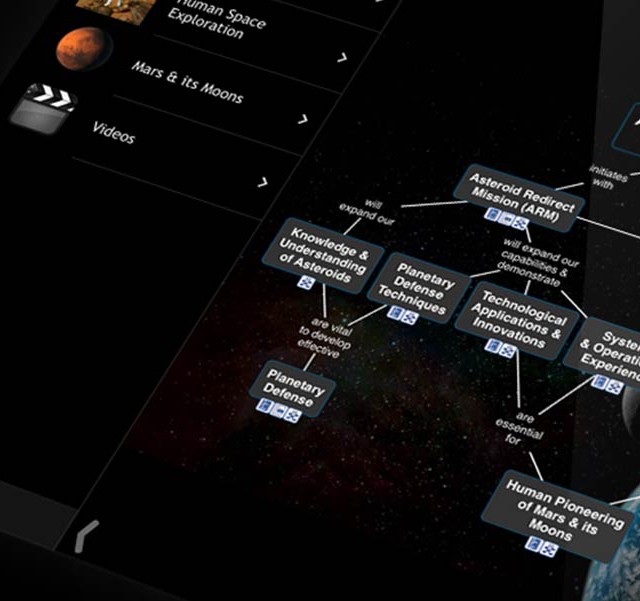
Published 9.10.15 NASA’s Asteroid Redirect Mission iPad App has been released and is available for free download at the iTunes Store. The creation of this novel App was a joint effort between NASA and IHMC. The App is a large knowledge model that uses dozens of concept maps to organize and navigate through hundreds of videos, images and Web links on NASA’s Asteroid Redirect Mission. Each of the concept maps represents the knowledge of experts on the particular topic. All concept maps in this app were constructed using the IHMC CmapTools software which is available free for download. Check our web page, download and experience the App, and then go give us a great review. 5 star reviews are warranted and appreciated! http://cmap.ihmc.us/armapp/
Undersea medicine scholar joins IHMC

Published 9.10.15 One of the country’s leading lights in the field of undersea medicine has joined IHMC as a research scientist in Pensacola, opening a new area of emphasis for the institute. Dr. Dawn Kernagis, who grew up near Raleigh, N.C., and spent much of her youth cave- and wreck-diving in Florida and around the world, comes to IHMC from Duke University, where her work was considered so pioneering, that she was awarded a grant from the U.S. Office of Naval Research before she even started her doctoral program. It was the first time ONR’s Undersea Medicine program had made such a grant. She went on to earn her doctorate at Duke in biomedical research and was a post-doctoral fellow there. Her work continues to shed new light on why some divers suffer decompression sickness and others don’t. “The idea is that some divers are susceptible and some aren’t — because of genetics,” said Dr. Kernagis, whose study will be published later this year. A big part of her work at IHMC will be focused on optimizing performance and mitigating risk for war fighters in extreme environments. That includes Navy divers, who can face unseen enemies: decompression sickness, oxygen toxicity and… Read More
CmapTools now available for iPad
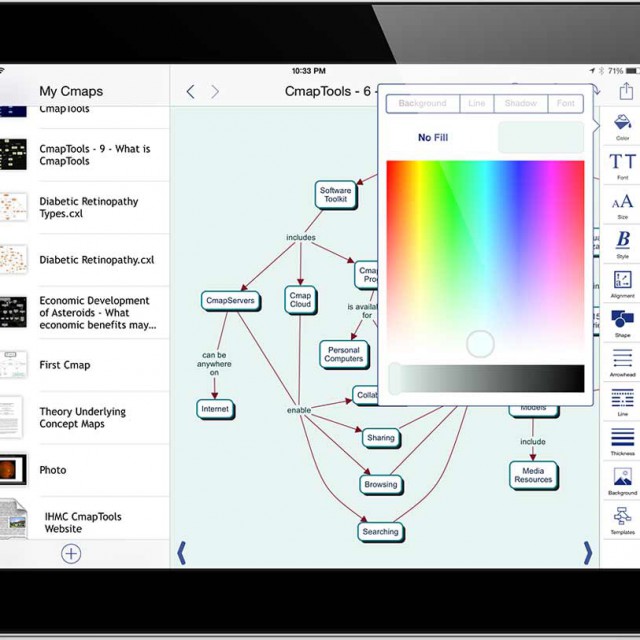
Published 9.10.15 CmapTools, the software used by millions of people around the world to build concept maps, is now available for the iPad. Researchers at the Florida Institute for Human and Machine Cognition (IHMC) have released a new version to the Apple App Store. “During our testing, the iPad version of CmapTools was particularly popular with elementary and high school students,” said IHMC Associate Director and Senior Research Scientist Dr. Alberto Cañas, the leading developer of CmapTools. “It’s amazing how fast elementary school students got into building the maps, and the speed at which they can build them using the iPad.” Concept maps are graphical tools for organizing and representing knowledge in an organized fashion. CmapTools empower users to construct, navigate, share and criticize knowledge models represented as concept maps. IHMC is a world leader and developer of software for concept mapping, which is used around the world by businesses, schools and universities. CmapTools has long been available for use on laptops and desktop computers, but the proliferation of the iPad created a demand for adapting the software for the versatile tablet. More than 225 million iPads have been sold since it was introduced in 2010. “If you are using… Read More
IHMC Scientist Named To Florida Inventors Hall Of Fame

Published 9.10.15 Jerry Pratt, one of the world’s leading researchers in the field of robotics, has been named to the Florida Inventors Hall of Fame, joining an august group of inventors which includes the likes of Thomas Edison. Pratt, a senior research scientist at the Florida Institute for Human and Machine Cognition (IHMC) in Pensacola, holds four patents on robotics inventions and is considered a rising star in the field. He is one of seven people with Florida connections who will be inducted into the Hall at an October ceremony in Tampa. Others in this group, the second year of inductees, include famed automaker Henry Ford and scientist Robert Grubbs, winner of the 2005 Nobel Prize in chemistry. “Collectively, the seven 2015 inductees hold more than 430 U.S. patents,” said Randy Berridge, chairman of the selection committee. “Their high merit has been recognized by national and international institutions and communities … and we are honored to be inducting them into the Florida Inventors Hall of Fame.” Pratt said he was honored and humbled by the recognition. “Sometimes I think what’s most fun about working in robotics is that we are practically inventing the field every day,” Pratt said. “There’s a long way to… Read More
Ken Ford receives top AAAI award

Published 9.4.15 The Association for the Advancement of Artificial Intelligence (AAAI) has awarded one of its highest honors, the AAAI Distinguished Service Award, to Dr. Ken Ford, director and CEO of the Florida Institute for Human and Machine Cognition (IHMC). The Distinguished Service Award, established in 1999, recognizes a single individual each year “for extraordinary and sustained service” to the artificial intelligence (AI) community. Dr. Ford is the 14th honoree. In a letter to Dr. Ford announcing the honor, Awards Committee Chair Manuelo Veloso wrote that he was “specifically honored for your contributions to the field of artificial intelligence through sustained service, including the founding of the Florida Institute for Human and Machine Cognition (IHMC), leadership roles at NASA, and your work on the advisory boards of federal science and technology research organizations.” In nominating Dr. Ford for the award, former NASA Administrator Michael D. Griffin said that, “Few technologies have greater potential benefit to humanity than does the field of artificial intelligence, and even fewer people are able to convey the essence and importance of the field to federal leaders in the fashion in which Ken Ford has done and continues to do it. He is quite simply a… Read More
IHMC Moves Ahead with Pensacola Expansion
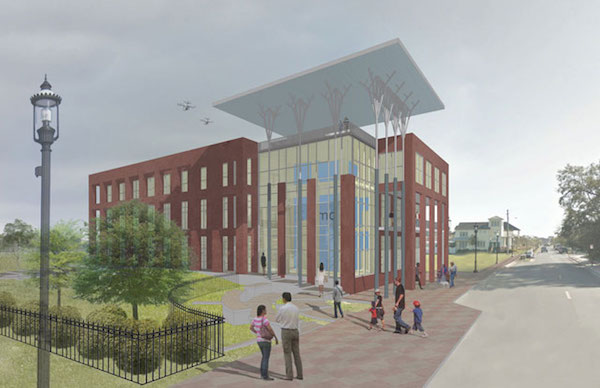
Published 9.4.15 The Florida Institute for Human and Machine Cognition is back on track with a planned expansion of its Pensacola research facility following a nearly year-long delay caused by flooding of downtown in April 2014. Completion is scheduled for February 2016. The contractor is Hewes and Company LLC, a Pensacola firm. Hewes has done extensive work across the Pensacola area, including large buildings for Pensacola Christian College, Avalex Technologies and AppRiver. “We’re really pleased to be back on track with the new building,” said IHMC Director and CEO Ken Ford. “The delay was troublesome, but the architects were able to develop some really good, workable solutions. We’re eager now to get this building built and keep growing in Pensacola.” In response to the flooding, the first floor of the new building was redesigned to raise it by one foot, to an elevation of 13 feet above sea level, and all structural materials were reviewed to ensure that they are water-resistant. Meanwhile, flood damage to the existing building has been repaired, but a planned expansion of that facility remains on hold. The three-story, 30,000-square-foot building will substantially increase IHMC’s Pensacola footprint, allowing consolidation of research and administrative functions at the… Read More
IHMC Board Member Cited for High Honor

Published 9.4.15 Dr. Alain T. Rappaport has been named a prestigious Fellow of the National Academy of Inventors (NAI). Dr. Rappaport is a member of the Florida Institute for Human and Machine Cognition (IHMC) Board of Directors and of its Science Advisory Council. Dr. Rappaport was cited as having “demonstrated a highly prolific spirit of innovation in creating or facilitating outstanding inventions that have made a tangible impact on quality of life, economic development, and the welfare of society.” The Tampa-based NAI was founded in 2010 “to recognize investigators at universities and non-profit research institutes who translate their research findings into inventions that may benefit society,” according to the group’s website. “To join, an inventor must be affiliated with a Member Institution and be a named inventor on one or more patents issued by the United States Patent and Trademark Office.” Dr. Rappaport is an Internet and software entrepreneur, the co-founder and CEO of Nudgit, Inc., an Internet company focused on intelligent choice. He received his M.D. from the Necker Sick-Children School of Medicine, René Descartes University, and his Ph.D. in Molecular Pharmacology from the Pierre and Marie Curie University in Paris. Prior to Nudgit, Dr. Rappaport was general manager… Read More
IHMC CEO on Panel Awarding Brain Research Money for NFL Partnership
Published 9.4.15 The NFL has announced seven winners of $500,000 brain research grants in Head Health Challenge II. Ken Ford, director/CEO of the Florida Institute for Human and Machine Cognition, serves on the six-person judging panel that selected the winners, who are eligible to receive up to $8.5 million to accelerate brain injury research, diagnosis and protection. The NFL’s partners in Head Health Challenge II are Under Armour and General Electric. The winners, which include researchers from the public and private sectors, were selected among nearly 500 proposals that were submitted between Sept. 2013 and Feb. 2014 from 19 countries. “We had to pick the winners from a long list of smart, innovative proposals that represent some of the best new ideas on how to prevent, diagnose and treat traumatic brain injuries,” Dr. Ford said. “It’s very rewarding to be able to be part of the Head Health Challenge II program. The implications go well beyond football.” Concern about traumatic brain injuries has been sparked by the increased awareness of problems stemming from a variety of causes, including the use of powerful improvised explosive devices (IEDs) and the increased awareness of concussions in football and other sports. Dr. Ford was… Read More
IHMC giving Atlas a leg up
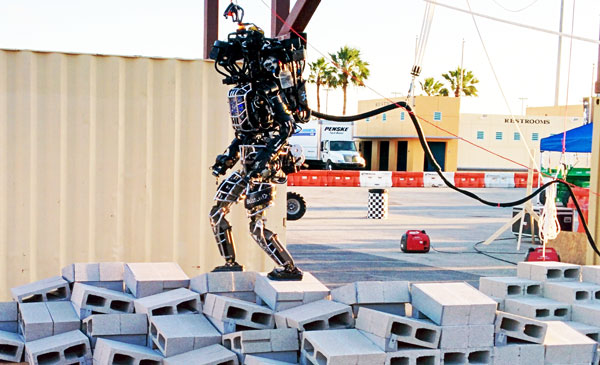
Published 9.2.15 The Florida Institute for Human and Machine Cognition (IHMC) continues to earn recognition for its development of software for the Atlas robot. A recent post on Tech Gen magazine notes IHMC’s work to advance the bipedal robot’s ability to walk more like a human. The IHMC Robotics Team has performed exceptionally well in the multi-year, international Robotics Challenge sponsored by the Defense Advanced Research Projects Agency (DARPA). IHMC came in first in the initial computer simulation trial in June 2013, and second overall in the second phase, which featured using actual robots in field trials at Homestead Miami Speedway in December 2013. The next phase of the competition, featuring more advanced field trials, is scheduled for June 5-6, 2015, in Pomona, California. At the Speedway, IHMC finished first among the seven teams using the Atlas robot and first among teams from the U.S. Through funding from DARPA, which provided the Atlas robots to the various teams, IHMC is now open sourcing its bipedal walking software for Atlas so that other research teams can use it on their robot. To read the Tech Gen article: http://techgenmag.com/2014/10/24/atlas-robot-gets-closer-to-walking-like-a-human/ To read more about IHMC and the DARPA Robotics Challenge: www.ihmc.us/news/20131223
Discovery Channel To Feature IHMC Exoskeleton
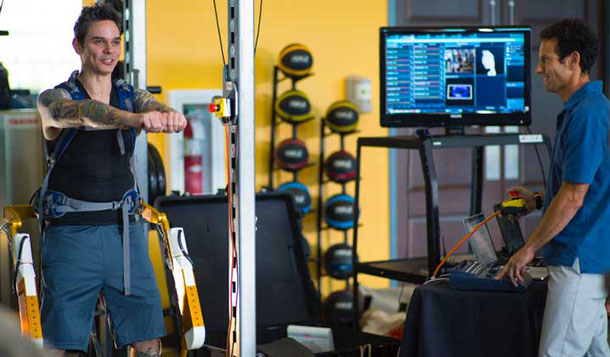
Published 9.2.15 An upcoming segment of The Discovery Channel’s Daily Planet program will feature a new exercise exoskeleton developed by researchers at the Florida Institute for Human and Machine Cognition (IHMC) in Pensacola. Called the Grasshopper, or Hopper, the device was designed, built and tested as part of a NASA-funded project exploring the use of robotic exoskeletons for microgravity exercise. Because the Hopper uses motors instead of gravity to create the load on the user, the device is suited for use on space missions. Exercise in zero-gravity conditions is critical to maintain muscle strength and bone mass. The Hopper is designed to replicate the effect of squat exercise with free weights, and its associated loading on the body. To test this claim, the Hopper was brought to EXOS, a leader in integrated performance training, nutrition and physical therapy for professional and elite athletes, the military and innovative corporations. EXOS has a center in Gulf Breeze, Fla., near IHMC. The IHMC team is led by Senior Research Scientist Peter Neuhaus. Members include Research Associate Nick Payton and student interns Travis Craig and Jeremy Gines. Noraxon, a company specializing in evidence-based biomechanics, provided sensors and technical analysis to compare exercise using the… Read More
IHMC robot sets world speed record
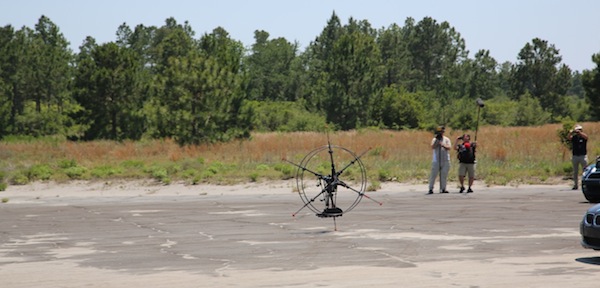
Published 9.2.15 A new land-speed record for legged robots was achieved on May 22 by researchers at the Florida Institute for Human and Machine Cognition (IHMC). The HexRunner robot reached an estimated 30-33 mph on an open course, without any support tethers. The record-setting run was filmed by the Discovery Channel, which is expected to broadcast it later this summer. The HexRunner running robot on its record-setting speed run. “More significant than the top speed is showing that you can make a running robot that doesn’t need a lot of feedback from sensors, and you don’t need a lot of actuation,” said IHMC Senior Research Scientist Jerry Pratt, team leader of the HexRunner project. HexRunner is a running robot with six spring-loaded legs revolving around a central hub, with three legs on each side of the hub. At the tip of the top leg it stands six feet high. Dr. Pratt said the speed was measured with a chase car and through analysis of high-speed motion video shot from the side. “The speedometer on the chase car hit 33 while the robot was still running away from it,” he said. The 30 mph documented speed is a conservative figure based… Read More
IHMC Scientist featured at inaugural STEM Symposium
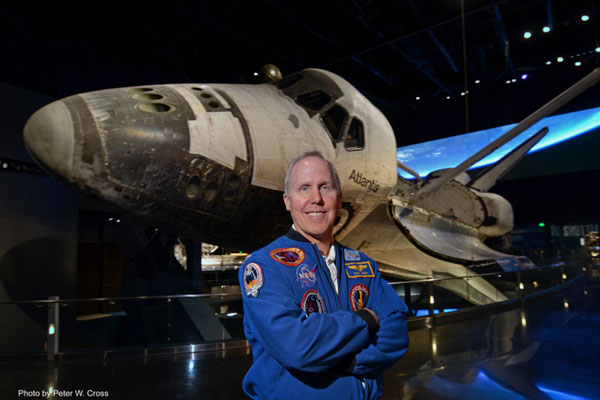
Published 9.2.15 Veteran Shuttle astronaut Tom Jones, a senior research scientist at the Florida Institute for Human and Machine Cognition (IHMC), will be a featured speaker at the first-ever X-STEM: Extreme STEM Symposium in Washington, D.C., on April 24. The symposium opens the third annual USA Science & Engineering Festival Expo and Book Fair, April 26-27, hosted by sponsor Lockheed Martin. Held at the Walter E. Washington Convention Center, X-STEM is a “TED-style” event for kids with talks by 50 of the nation’s most noted science, technology, engineering and mathematics (STEM) professionals representing top universities, corporations, non-profits and governmental agencies. “I’m honored to speak at X-STEM and get to meet some of our future explorers,” Jones said. “Exciting our young people about science, technology, engineering and math — so they can write the next chapter in the history of space exploration — is crucial to America’s future. I hope I can help energize tomorrow’s explorers, scientists, inventors and entrepreneurs. They’re the ones who will revitalize and maintain our competitive, vibrant economy.“ Jones is a veteran NASA astronaut, planetary scientist, author and speaker. He flew on four space shuttle missions, and led three spacewalks at the International Space Station (ISS) to… Read More
Bradshaw to chair new Nissan advisory board
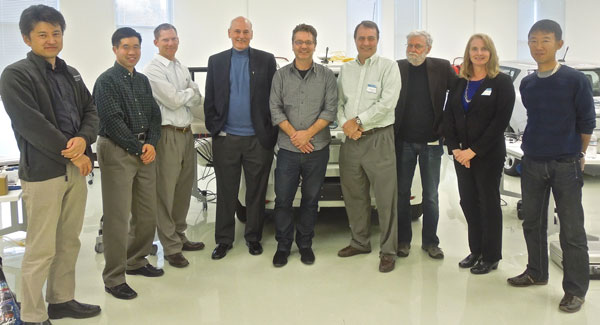
Published 9.2.15 IHMC Senior Research Scientist Jeff Bradshaw has been named chair of the inaugural Scientific Advisory Council for the Nissan Research Center — Silicon Valley, in Sunnyvale, Calif. The advisory group will give guidance on matters of science, technology, research and other similar topics of special interest to Nissan Motor Corporation. That includes research regarding autonomous vehicles, connected vehicles, human machine interactions and other matters of special interest to Nissan. “I’m excited to work with this stellar group of experts,” Dr. Bradshaw said. “Nissan’s commitment to a human-centered, rather than a technology-centered, design approach puts them in a unique and enviable competitive position. As a result, they will produce well connected, environmentally aware and highly capable vehicles that excel in their safety, usability and usefulness.” The other members of the board are James Euchner, vice president of Global Innovation, Goodyear Tire & Rubber Company; Dr. Don Norman, co-founder of the Nielsen Norman Group; Dr. Missy Cummings, associate professor at Duke University and director of the Humans and Autonomy Laboratory; and Dr. Terry Fong, director of the Intelligent Robotics Group at the NASA Ames Research Center. Human-Agent-Robot Teamwork has been a central interest for Dr. Bradshaw. From 2002-2006, IHMC’s KAoS… Read More
Dr. Bonnie Dorr joins IHMC as an associate director, senior scientist

Published 9.2.15 Dr. Bonnie J. Dorr, a leading researcher in the field of natural language processing, is joining the Florida Institute for Human & Machine Cognition (IHMC) as an associate director and senior research scientist at IHMC’s Ocala facility. Natural language processing is a growing research field at IHMC, and Dr. Dorr’s expertise is at the cutting edge. Her extensive research and project management experience includes deep language understanding and semantics, large-scale multilingual processing (including machine translation), and summarization. “We’re clearly pleased to add someone of Bonnie’s expertise and accomplishments,” said IHMC Director/CEO Ken Ford. “Her vision, passion and experience make her a perfect fit for IHMC.” Dr. Dorr joins IHMC from the University of Maryland, where she was a professor in the Institute for Advanced Computer Studies and the Department of Computer Science. She was an associate dean of the College of Computer, Mathematical and Natural Sciences, and co-founded the Computational Linguistics and Information Processing Laboratory. She was also principal scientist for two years at the Johns Hopkins University Human Language Technology Center of Excellence. In 2011 she became a program manager at the Defense Advanced Research Projects Agency (DARPA), overseeing research in human language technology. Her significant DARPA… Read More
IHMC Robotics featured on CNN
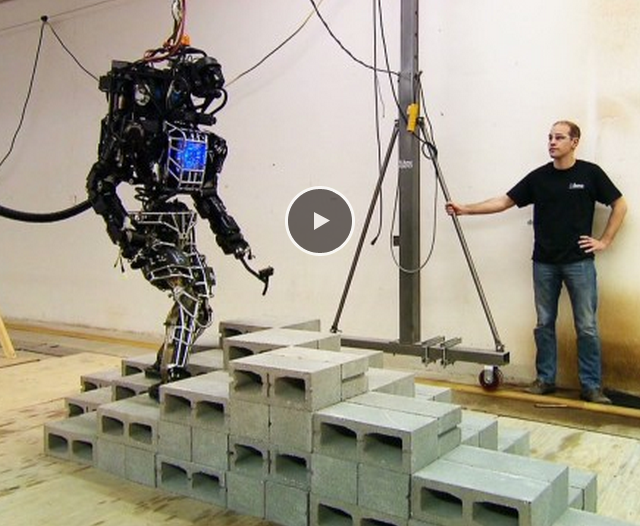
Published 9.2.15 The work of the IHMC Robotics team with the Atlas humanoid robot is featured in an episode of a new monthly CNN program, The Art of Movement. The four-minute-plus feature can be seen online here: http://edition.cnn.com/video/data/2.0/video/world/2014/03/06/spc-art-of-movement-automata-b.cnn.html The segment features interviews with IHMC scientists and extensive video shot both in the IHMC Robotics Lab in Pensacola and at the DARPA Robotics Challenge (DRC) trials at Homestead Miami Speedway in December 2013. IHMC’s own video team shot some of the footage used by CNN, especially from the DARPA trials. The episode focuses on IHMC’s work with the two-legged Atlas robot, built by Boston Dynamics and used in the DRC competition. The teams participating in the DRC represent some of the most advanced robotics research and development organizations in the world. They are collaborating and innovating on a very short timeline to develop the hardware, software, sensors and human-machine control interfaces that will enable their robots to complete a series of challenge tasks selected by the Defense Advanced Research Projects Agency for their relevance to disaster response. IHMC finished first in the initial stage of the DRC in June 2013, a computer simulation competition dubbed the Virtual Robotics Challenge. The robotics team… Read More