

Levin Center for IHMC Research nominated for architectural award
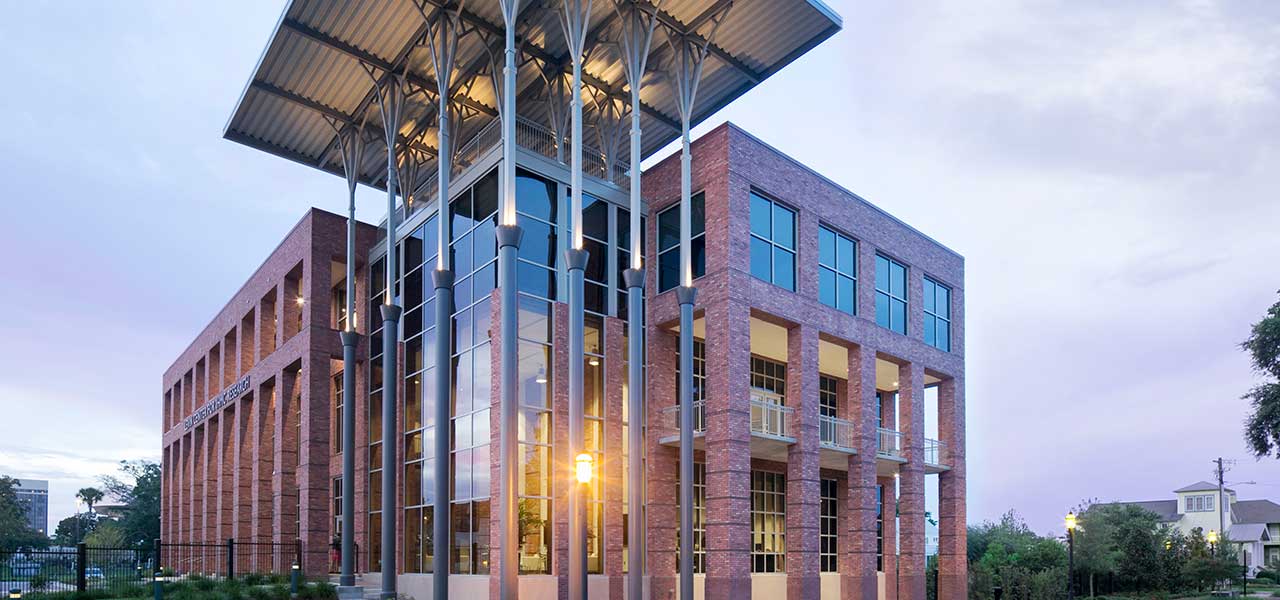
Published 6.28.18 The Levin Center for IHMC Research is one of 39 buildings nominated for the fifth annual People’s Choice Competition launched by the Florida Association of the American Institute of Architects and the Florida Foundation for Architecture. People from around the world can go online to vote for the Levin Center as well as their other favorite buildings in Florida. The buildings that have been nominated were built in the past five years and contribute to the happiness and prosperity of Florida residents. The 30,000-square-foot Levin Center was designed by Quina Grundhoefer Architects and won an award of excellence at last year’s meeting of the Florida Northwest Chapter of the American Institute of Architects. Help put Pensacola on the map and go online by July 20 and vote for the Levin Center at floridapeopleschoice.com. Buildings are listed by the structure’s name and city. The results of the voting will be announced at the American Institute of Architects Florida annual convention on July 21.
Ewers donate $500,000 to IHMC
Published 6.21.18 Ron and Phyllis Ewers have donated $500,000 to the Florida Institute for Human and Machine Cognition, a gift that will allow the research center to make some needed improvements to its glass-enclosed building in downtown Ocala. IHMC’s Ocala facility was once the home of Marion County’s main branch of its public-library system. Built in the 1960s, the building’s futuristic look became a focal point of Ocala’s downtown. In 2009, the then vacant facility fell into the hands of IHMC, a not-for-profit research institute that is part of the Florida University System with branches in Ocala and Pensacola. “I was so glad to see IHMC move into the building,” said Ewers, who moved to Ocala in the 1970s and serves on the institute’s board of directors. “The building and the work that goes on at the institute has really become one of Ocala’s jewels.” One of the distinctive features of the building is the skylight in the center of the roof. But after 60 years, the glass in the skylight has taken on a smoky look. “Thanks to this gift, we will be able to replace the roof and skylight,” said Laurie Zink, development and community outreach director for… Read More
Studers Donate $1 Million to Further IHMC New Initiatives
Published 4.17.18 Quint and Rishy Studer have generously donated $1 million to the Florida Institute for Human and Machine Cognition. Studer said the gift to IHMC was a natural step for him and his wife, Rishy. “When I taught special education, the whole goal was to maximize a person’s capabilities. When we formed the Studer Group, it was the same thing…our mission was about maximizing human potential. And that’s what the Studer Community Institute and EntreCon and CivicCon are also about. So, when you look at what IHMC does, it also strives to maximize people’s human potential. That’s why this gift just feels like a natural stair step for Rishy and me.” IHMC is a not-for-profit research institute that has grown into one of the nation’s premier research organizations with world-class scientists and engineers investigating a broad range of topics related to building technological systems aimed at amplifying and extending human cognition, perception, locomotion and resilience. The institute is part of the Florida University System and is based in Pensacola with a branch in Ocala. “Quint told us we could use the gift for anything we want, which was great,” said IHMC co-founder and CEO Ken Ford. “But when I… Read More
Former NFL Coach Joins IHMC

Published 4.9.18 The former Head Strength and Conditioning Coach for the Oakland Raiders who has also worked with the Department of Defense on pioneering human performance programs joins IHMC as the High Performance Director. Joe Gomes has 17 years of international experience as a head coach and high-performance director responsible for developing staffs and systems that evaluate and prepare elite professional athletes and the elite warfighter for peak performance. As Gomes transitions into his new role within IHMC, he is focused not only on supporting existing research in human performance and resilience, but also looking to draw from IHMC’s collective expertise to support high performing and elite populations with actionable solutions and countermeasures. He is passionate about supporting career longevity in high performing populations. “Over the past several years we have broadened our research on human performance and resilience,” said IHMC co-founder and CEO Ken Ford. “Joe brings a wealth of real-world experience in these areas to IHMC and will contribute a great deal to the research we’re doing along these lines.” In addition to his time with the Oakland Raiders, Gomes spent 2007 to 2010 as the NFL combine preparation director for EXOS, a human performance company. He worked… Read More
IHMC scientist wins international recognition
Published 12.15.17 Peter Pirolli of the Florida Institute for Human and Machine Cognition is joining an elite group of global inventors whose patents and research have helped improve the world’s quality of life. The National Academy of Inventors named Pirolli and 154 other inventors from around the world to its class of 2017 NAI Fellows. Election as an NAI fellow is among the highest professional accolade bestowed to academic inventors at universities and research institutions worldwide. Before joining IHMC earlier this year, Pirolli was a research fellow in the Interactive Intelligence Area at the Palo Alto Research Center (PARC) where he studied human information interaction. “This is a wonderful recognition for Peter,” said IHMC founder and CEO Ken Ford. “Peter is a leader the field of complex human-information interaction systems. It doesn’t surprise me that NAI would name Peter a fellow. Peter holds 74 patents and is among the most talented and versatile researchers that I know.” With the election of the 2017 class, there are now 912 NAI Fellows worldwide who collectively hold more than 32,000 patents. NAI fellows have helped create more than 9,400 technologies and companies which have generated 1.3 million jobs and more than $137 billion… Read More
Airport display showcases IHMC Research
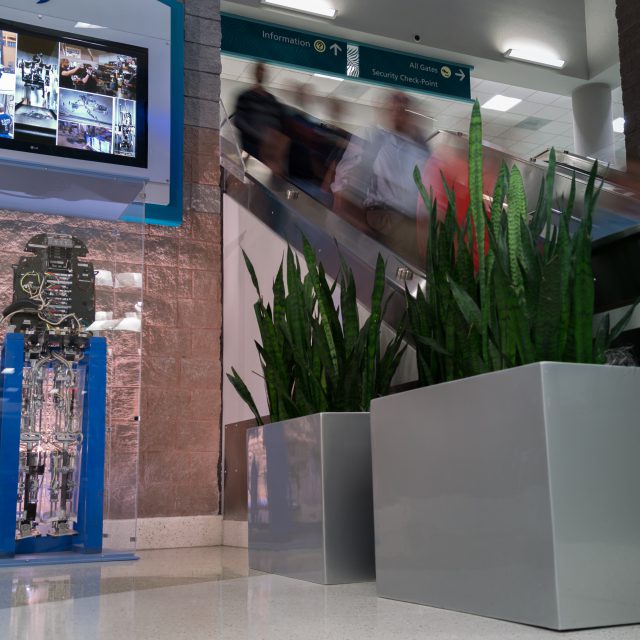
Published 11.2.17 The next time you’re passing through the Pensacola International Airport, be sure to check out the IHMC research display. Several IHMC robots, including the M2V2 humanoid, Spring Flamingo, Mina Exoskeleton, and tBot, will be on display at the airport on a rotating basis. The display case is located at the main entrance of the airport next to the escalator. There is a monitor above the display case that highlights many areas of IHMC’s research. Brix Design in downtown Pensacola designed and fabricated the acrylic case that houses the robots. The current robot in the display is M2V2, developed by IHMC in collaboration with the MIT Leg Laboratory, Yobotics, Bucknell University, Delft University of Technology, University of Michigan, and Honda Research Institute. It will be featured until the Spring of 2018. The next robot on display will be the NASA-IHMC X1 Mina Exoskeleton, a robotic device developed for mobility assistance for abled and disabled users. We also will continue to update the video feed on the monitor to showcase new IHMC research. Please let us know your thoughts as you view this display and be sure to tell friends to stop by next time they are at the airport.
STEM-Talk wins first place

Published 10.4.17 IHMC’s podcast STEM-Talk won first place in the science and medicine category at the 12th Annual People’s Choice Podcast Awards on Sunday. The international competition featured more than 2,000 nominees in 20 categories. STEM-Talk also was a runner-up in the People’s Choice Award, the grand prize of the competition. STEM-Talk bills itself as “conversations with some of the most interesting people in the world of science and technology.” “We really didn’t expect this,” said Ken Ford, IHMC’s founder and CEO, who came up with the idea for STEM-Talk. “Our podcast is just a little more than a year old and we’re thrilled to receive this kind of recognition so soon.” STEM-Talk uploads to iTunes every other Tuesday and is nearing its 50th episode. Ford co-hosts the podcast with IHMC research scientist Dawn Kernagis. Veteran NASA astronaut Tom Jones, who also is a senior research scientist at IHMC, has co-hosted several episodes of STEM-Talk. STEM-Talk is edited by IHMC Senior Creative and Multimedia Specialist William “Billy” Howell and Communications Director Randy Hammer is the show’s producer. The Oct. 24 episode will feature Kernagis interviewing Ford about artificial intelligence and the founding of IHMC. Ford, an early adapter of a… Read More
Florida Inventors Hall of Fame honors Ken Ford as 2017 Inductee
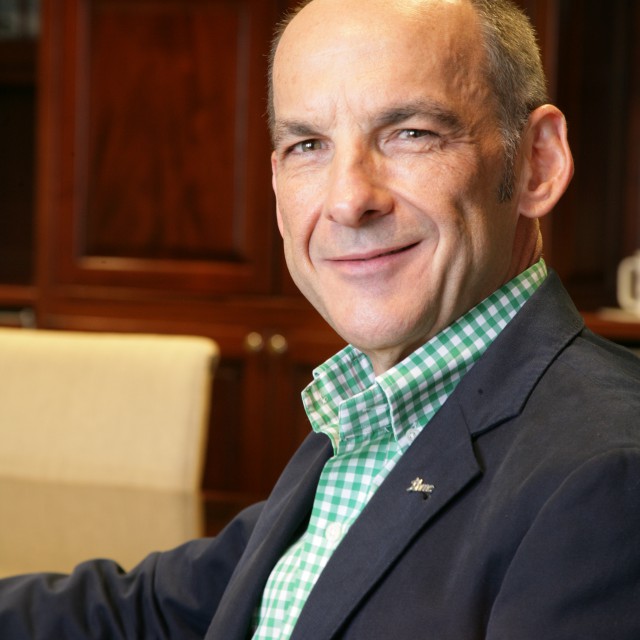
TAMPA, Fla. (Mar. 22, 2017) – The Florida Inventors Hall of Fame announced today that the Florida Institute for Human and Machine Cognition co-founder and CEO Ken Ford is among the eight inventors who will be inducted into the 2017 Florida Inventors Hall of Fame in September. Ford is being recognized for his pioneering work in artificial intelligence and human-centered computing as well as his significant contributions to the United States and Florida’s technology and research communities. The Hall of Fame particularly highlighted Ford’s role in the 1990 co-founding of IHMC. The not-for-profit research institute, which is headquartered in Pensacola and has a second location in Ocala, has grown into one of the world’s premier research organizations. Ford was instrumental in bringing scientists and engineers from around the globe to Florida and IHMC to investigate a board range of topics related to building technological systems aimed at amplifying and extending human cognition, perception, locomotion and resilience. “The list of inductees and their accomplishments is quite amazing,” said Ford. “I am very honored to be included with such a distinguished group of people.” Ford holds two patents and is the author of hundreds of scientific papers and six books whose topics… Read More
Inventors Academy Honors Prolific IHMC Scientist
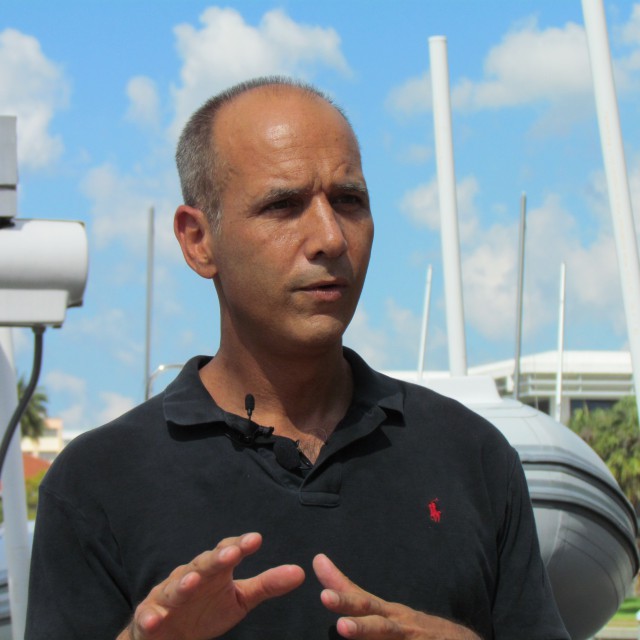
Published 12.13.16 David Fries has been named a prestigious Fellow of the National Academy of Inventors (NAI). David is an interdisciplinary research scientist at the Florida Institute for Human and Machine Cognition (IHMC) and an expert and true innovator in undersea technologies, especially microsystems and robotics for sensing applications, advanced sensor development, and mobile robotic systems for field applications. He holds more than 35 U.S. patents, 13 of which have been licensed to seven separate companies. David was cited as having “demonstrated a highly prolific spirit of innovation in creating or facilitating outstanding inventions that have made a tangible impact on quality of life, economic development, and the welfare of society.” The NAI was founded in 2010 “to recognize investigators at universities and non-profit research institutes who translate their research findings into inventions that may benefit society,” according to the group’s website. In addition to his research at IHMC, David is the co-founder of Intelligent Micropatterning LLC, the co-founder and CTO of Spyglass Technologies, Inc., the founder of non-profit SciFlies.org, and the co-founder of Guided Particle Systems, Inc. He has published more than 60 technical articles and has been featured in more than 50 media articles and broadcasts. Fries is… Read More
Dr. Bonnie Dorr Cited for High Honor

Published 12.5.16 Dr. Bonnie Dorr, associate director and senior research scientist at the Florida Institute for Human & Machine Cognition (IHMC), has been named a fellow of the Association for Computational Linguists (ACL). She is one of four people to be named to this year’s class of ACL fellows. The honor is in recognition of Dorr’s contributions to the field of computational linguistics. “Bonnie’s work over the years has certainly earned her this well-deserved recognition,” said Ken Ford, the founder and chief executive of IHMC. “She is an exceptional scientist and colleague who has contributed greatly to the advancement of computational linguists.” In naming Dorr one of its 2016 fellows, ACL specifically highlighted her “significant contributions to machine translation, summarization and human evaluation.” Dorr’s research spans several areas of broad-scale multilingual processing, including machine translation, summarization, and cross-language information retrieval. Dorr, a professor emeritus of computer science, leads a team of scientists and researchers at IHMC’s Ocala facility. Dorr is the former associate dean of the College of Computer, Mathematical, and Natural Sciences at the University of Maryland. She co-founded the Computational Linguistics and Information Processing Laboratory at Maryland, and served as its co-director for 15 years. In 2008, she… Read More
IHMC Wins Silver Medal in Cybathlon
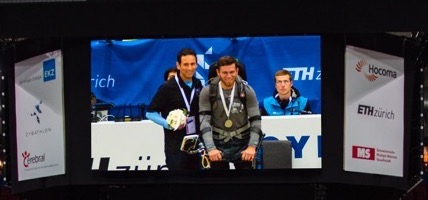
Published 10.13.16 In a weekend international showdown, the Florida Institute for Human & Machine Cognition (IHMC) robotics team once again demonstrated its brawn as it placed a strong second in the powered exoskeleton division of the first annual Cybathlon. Held October 8th, in Zurich, Switzerland, the Cybathlon is a global competition for disabled athletes aided by wearable robotic devices. The unique competition hosted 66 teams from across the globe, competing in six distinct divisions. Using the Mina v2 exoskeleton, developed at IHMC’s research facility in Pensacola, Florida, the IHMC pilot athlete was Mark Daniel. Daniel, who grew up in Pensacola, suffered a spinal cord injury in 2007 as a result of a car accident, which left him paralyzed. He began assisting the IHMC research team in 2010, with the evaluation and testing of powered exoskeletons. Senior Research Scientist Peter Neuhaus, the lead researcher on the project, said, “I am very proud of our team’s Silver Medal finish in the Powered Exoskeleton race. This competition was open to researchers and companies throughout the world, and to finish just behind an established company affirms our position in the field.” German-based company ReWalk won first place in the competition, represented by Andre Van… Read More
IHMC Dedicates Innovative “Levin Center for IHMC Research”
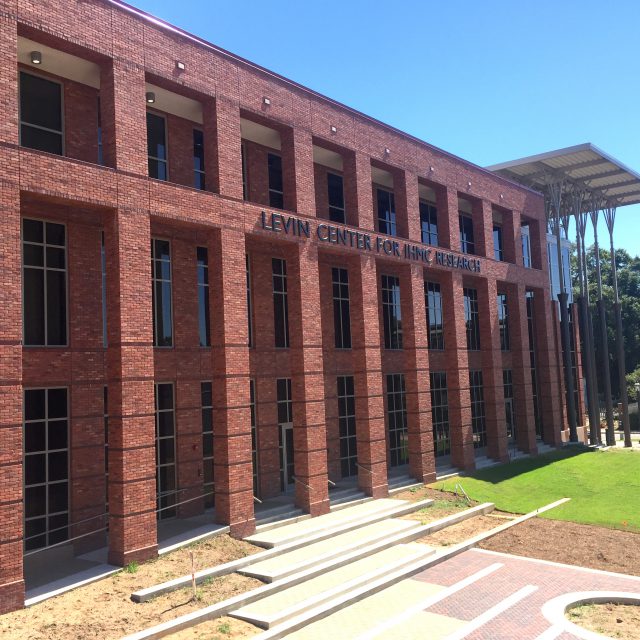
Published 9.26.16 The Florida Institute for Human and Machine Cognition, (IHMC), officially opened its new, state of the art research facility named after Fredric Levin, a prominent, successful Pensacola businessman and lawyer. On Monday, Sept. 26, 2016, IHMC hosted a building dedication, ribbon cutting, and unveiled the name of the building followed by an open house and tours of the new facility. The event, attended by several hundred people, was hosted by IHMC Director, Dr. Ken Ford and the IHMC Board of Directors and emceed by IHMC’s Dr. Pamella Dana. Also speaking at the event was the IHMC Board Chair Bill Dalton, Escambia Board of County Commissioners Chair Grover Robinson, Pensacola Mayor Ashton Hayward, and IHMC CEO Ken Ford. The donor, Fredric Levin, who made a one million dollar cash gift to IHMC, was the keynote speaker at the event. “The opportunities facilities like the IHMC offer Pensacola are amazing,” said Levin. “IHMC is bringing brilliant researchers to our area where people can learn and benefit from them in a wide range of areas, like robotics, medicine, and technology. My $1 million dollar donation is for not only the future of our community, but for the benefit of all mankind.”… Read More
Dawn Kernagis Joins NASA’s Undersea Mission

Published 6.22.16 Dr. Dawn Kernagis, a Research Scientist at the Florida Institute for Human and Machine Cognition (IHMC) and host of STEM-Talk, has been chosen as one of six crew members to join NASA’s undersea analog mission, NEEMO (NASA Extreme Environment Mission Operations). Living on the bottom of the Atlantic Ocean, the 21st NEEMO crew will focus on evaluating tools and techniques being tested for future space exploration by living in simulated spacecraft conditions and conducting simulated spacewalks outside of their undersea habitat. The NEEMO 21 crew and two professional habitat technicians will live 62 feet (19 meters) below the surface of the Atlantic Ocean at the The Aquarius Undersea Reef Base, owned and operated by Florida International University under permit by NOAA and the Florida Keys National Marine Sanctuary. Inside the habitat, the international crew will conduct a variety of research and operational studies, such testing a mini DNA sequencer and a medical telemetry device that will be used for future space applications. During their simulated spacewalks, the crew will collect samples for marine biology and geology studies, team with underwater remote operating vehicles, test operational software, and participate in a coral restoration project. Throughout many of these tasks,… Read More
IHMC Designated Bronze-level Bike-Friendly Workplace

Published 5.17.16 IHMC is officially a bike-friendly work place. The League of American Bicyclists recognized IHMC as a bronze level Bicycle Friendly Business (BFBSM). IHMC joins a cutting-edge group of nearly 1,200 local businesses, government agencies and Fortune 500 companies across the United States that have a bike-friendly designation. “The business community’s investment in bicycling is playing a central role in making the country a safer, happier, and more sustainable place to live and work,” said Amelia Neptune, League Bicycle Friendly Business Program Manager. “We applaud this new round of businesses, including IHMC, for leading the charge in creating a bicycle-friendly America for everyone.” The designation lasts for four years, and is renewable thereafter. Before that, IHMC can re-apply for a higher designation. Tim Bustos, Principal at Sustainable Transportation Planning & Design commented, “On behalf of Bike Pensacola, I’d like to congratulate IHMC on being awarded a “Bicycle Friendly Business” award at the “Bronze Level.” The criteria developed by LAB is challenging at best, so many businesses don’t even get an “honorable mention” the first time they apply. The fact that IHMC came in at the Bronze level the first time around demonstrates their commitment to a more bikeable community,… Read More
Dalton Inducted to 2016 Florida Inventors Hall of Fame
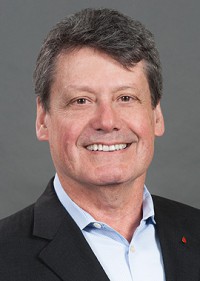
IHMC Board of Directors Vice Chair Dr. William Dalton to be Inducted into 2016 Florida Inventors Hall of Fame TAMPA, Fla. (Mar. 15, 2016) –Dr. William (Bill) Dalton, Founder and CEO of M2Gen®, a subsidiary of Moffitt Cancer Center & Research Institute in Tampa, and Vice Chairman of the IHMC Board of Directors is among the seven inventors announced today as the 2016 inductees of the Florida Inventors Hall of Fame. Bill Dalton was nominated and approved as an inductee for his revolutionizing developments in cancer treatment and he will be inducted at the Florida Inventors Hall of Fame 3rd Annual Induction Ceremony & Gala on Sep. 16, 2016, in Tampa. Nominees, who must have at least one U.S. patent and a connection to Florida, were nominated through an open nomination process and elected by a selection committee comprising distinguished leaders in research and innovation throughout Florida. Bill will join IHMC Senior Scientist and Inventor Dr. Jerry Pratt who was inducted into the Florida Hall of Fame in 2015. “We are delighted to be announcing this class of exceptional inventors whose work has greatly impacted Florida and our nation,” said Randy Berridge, who serves on the Florida Inventors Hall of… Read More
Nova: Rise of the Robots
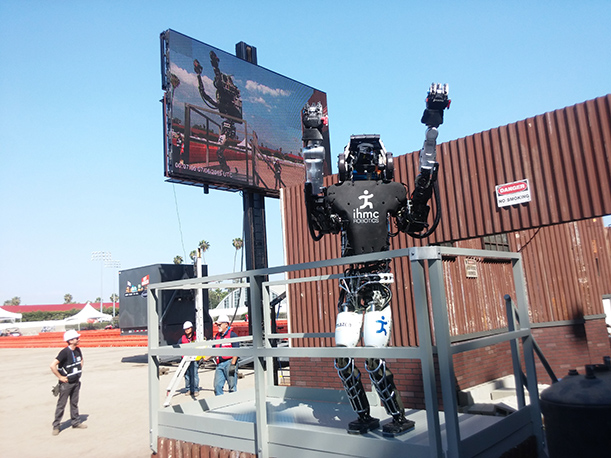
Published 2.24.16 The Running Man is at it again. IHMC’s “Atlas robot,” which placed second in the Defense Advance Research Projects Agency (DARPA)-sponsored international robotics competition last summer, will be featured in a NOVA documentary this evening, Wednesday, Feb. 24th, called “Rise of the Robots.” It explores how robots are gradually making their way into the real world, with questions such as: “How close are we to a future where humanoid robots are part of our everyday lives? What are the implications of a future with robots that can do a human’s job?” The DARPA competition, held last June in Pomona, California, involved 23 teams from around the world, whose robots competed against each other in completing eight tasks such as driving a car and cutting a hole in the wall. A South Korean robot, DRC-HUBO, placed first, finishing six minutes faster than IHMC’s Atlas, the 6’2” robot weighing more than 380 pounds. Built by Boston Dynamics, the IHMC team, led by Jerry Pratt, John Carff, Peter Neuhaus and Matt Johnson, spent several years working on the robot’s software and controls. IHMC researchers continue to run the robot everyday, tasking Atlas with new challenges such as vacuuming, sweeping, dancing, and… Read More
Bill Clancey Named NAI Fellow

Published 12.15.15 As a mathematical sciences major at Rice University in the 1970s, William “Bill” Clancey took courses in 13 different departments—ranging from philosophy and anthropology to art and music. But it was a cover story in Life Magazine about Shakey, the first robot who could analyze and carry out consecutive commands, that opened up Clancey’s world onto the newly emergent field that he would spend much of his career working on: artificial intelligence. Clancey was especially interested in the philosophical and psychological underpinnings of artificial intelligence, pondering questions such as: What is the nature of knowledge? What can computers do? Can knowledge be converted into a program? “You really need to understand people and psychology if you are going to build a smart machine,” he said. Those initial insights led Clancey down the path of a brilliant career that includes holding six patents and establishing two software companies. Most recently, Clancey, a senior research scientist with the Florida Institute for Human and Machine Cognition (IHMC), was named a Fellow of the National Academy of Inventors (NAI). The Tampa-based Academy named a total of 168 Fellows this week, bringing the total number of Fellows to 582. This is the fourth… Read More
Dawn Kernagis Inducted into Women Divers Hall of Fame
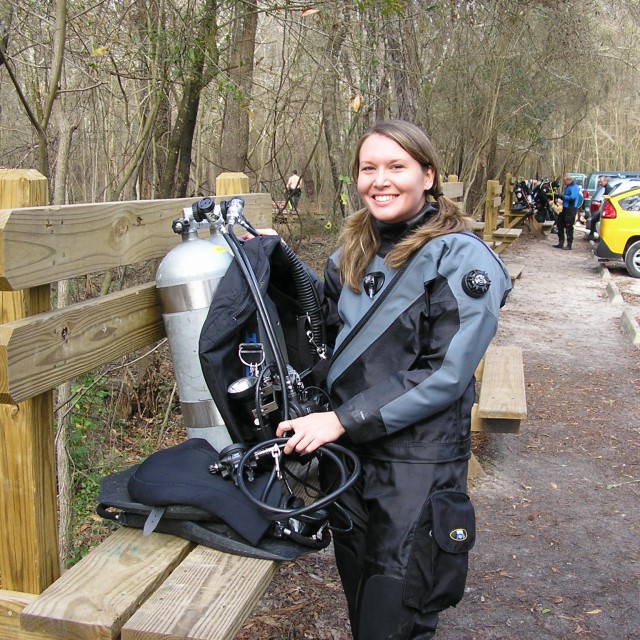
Published 12.8.15 When Dawn Kernagis went to the ocean for the first time as a nine-year-old, she knew that she wanted to explore its depths. She had just moved from Iowa to North Carolina. “I became completely intrigued by the ocean,” she said. “I wanted to be a marine biologist. I started to read everything I could get my hands on.” Her parents gave her scuba diving lessons as a birthday present when she turned fifteen, and she would spend the better part of the next two decades in the sea or studying it. Recently, Kernagis, who is a Research Scientist at the Institute for Human and Machine Cognition (IHMC) in Pensacola, where her research focuses on risk mitigation for divers, was named one of six women who will be inducted into the Women Divers Hall of Fame (WDHOF) in 2016. The WDHOF is a non-profit, professional honor society that recognizes outstanding women divers who have made substantial contributions to contributions to the exploration, understanding, safety and conservation of the underwater world. The society also provides financial assistance and mentorship to people interested in pursuing diving careers. Kernagis said she will be working on the scholarship committee, which grants 16… Read More
Undersea Technology Expert David Fries Joins IHMC
Published 11.30.15 The day that a tree can talk—telling you about its ancestry and physical composition, and the air it breathes—is the future that David Fries envisions. “Rather than sit in a classroom where you have representations of a tree on a white board, you are actually in proximity of the tree and can see visualizations of its chemistry, biology and sustainability,” Fries said. In practice, this means that a mobile device could see a tree and then start tracing the flow of nutrients from its roots to its branches. This “fusion of education and entertainment,” Fries said, is one area that he intends to work on as a recently-hired research scientist at the Florida Institute for Human and Machine Cognition (IHMC). The Tampa-based scientist, who has been on faculty at the University of South Florida for two decades, will work at both the Ocala and Pensacola IHMC locations until next summer, when he re-locates to Pensacola. Fries’ main area of specialization is undersea technology. He holds 35 patents in the field, and is best known for inventing underwater sensors and robots that can determine the extent of oil spill contamination, detect submarines (or other robots), and help take fish… Read More
Ken Ford named AAAS Fellow
Published 11.24.15 The American Association for the Advancement of Science (AAAS) has elected Ken Ford, director and CEO of the Florida Institute for Human and Machine Cognition (IHMC), as a Fellow. Ford is one of 347 scientists who have been named Fellows this year. The electing Council elects people “whose efforts on behalf of the advancement of science of its applications are scientifically or socially distinguished.” According to a press release from AAAS, Ford was selected “for founding and directing the IHMC, for his scientific contributions to artificial intelligence and human-centered computing, and for service to many federal agencies.” “I am truly honored to be inducted as an AAAS Fellow,” Dr. Ford said. “The advancement of science is what we strive for every day at IHMC; to be recognized for it by scientists is a reward in itself.” IHMC, which Ford founded in 1990, is known for its groundbreaking research in the field of artificial intelligence. It employs scientists and engineers from around the world who are investigating topics related to building technological systems aimed at amplifying and extending human cognitive, physical and perceptual capacities. Its headquarters are in Pensacola, Fla., with an associated research facility in Ocala, Fla. Ford… Read More