

IHMC hosts national workshop on collaborative autonomy
 The nature of military conflicts has changed. In the past, drones and unmanned systems had a small impact. But as we are seeing in Iran and Ukraine, unmanned systems are now having a dominant impact.
“It shouldn’t come as a surprise that drones and other unmanned autonomous systems are having a bigger impact than they did 10 years ago,” says IHMC Senior Research Scientist Matt Johnson. “It also should not be a surprise that if you can scale unmanned systems better, you will have a significant advantage in future conflicts.”
The problem in terms of military conflicts is that each drone or unmanned platform is operated by one war fighter, says Niranjan Suri, a Senior Research Scientist and Associate Director at IHMC.
“Right now, there’s typically one war fighter in the field driving one drone. But if you talk to people in Ukraine, they would like to launch 100,000 drones at the same time. The problem is they don’t have 100,000 pilots. This is why we need to get where a war fighter is not commanding a single unmanned autonomous vehicle, but commanding a whole fleet of drones and autonomous systems.”
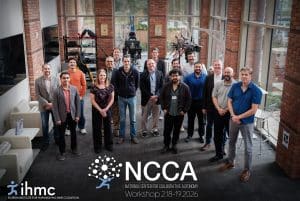
This in a nutshell is what IHMC’s newly created National Center for Collaborative Autonomy is all about. It’s also what drew 13 people from nine top national universities to Pensacola to talk about beginning a new research community around collaborate autonomy. During the invitation-only workshop, researchers worked on identifying the barriers to scaling the use of autonomous systems in multi-domain operations. They also brainstormed the fundamental capabilities necessary to move beyond these barriers.
“The goal of the workshop was to find common areas of research and also mechanisms by which we could collaborate,” says Niranjan. “It became apparent that all these different organizations that came to the workshop have different strengths and that we can complement each other by working together to address the problems that the military and its autonomous systems are facing.”
IHMC created the National Center for Collaborate Autonomy (NCCA) after receiving a $6.7 million grant from the Triumph Gulf Coast Board. Triumph is a nonprofit corporation funded by a legal settlement with British Petroleum following the Deepwater Horizon oil spill in 2010. IHMC has long been recognized for its expertise in drones and autonomous systems. By leveraging this expertise with the expertise of other organizations in cooperative human-machine teaming, the NCCA has the potential to become a driving force for shaping the future of military conflicts as well as protecting the nation’s security and economic interests.
As Johnson points out, right now we have warfighters out in the field wearing goggles and holding a joystick. “So the problem is that they can only control one drone when ideally they could be able to control something like 20 drones. But because you can’t control 20 drones with one joystick, we need something different. And that in my mind is what the NCCA is about. How do we scale the use of drones and other autonomous systems and the impact that we now seeing them have in Ukraine and Iran? Whoever can scale autonomous systems first is going to have a big leg up on the rest of the world.”
Militaries around the world, according to Suri and Johnson, are focused two things: how to optimize unmanned aerial systems, especially Kamikaze drones, and how to counter these unmanned aerial systems.
“What if instead of having one Kamikaze drone, you have an adversary in the field who now has 50. So how do you come up with mechanisms by which you can counter or prevent an attack by 50 Kamikaze drones?”
This, however, isn’t the only issue militaries are facing.
“It’s not just about the coordination amongst aerial drones, but how do they then collaborate with surface robots that might be out at sea or undersea robots? And this is what we mean by multi-domain collaborative autonomy. And that’s really where we are trying to go. And of course, we have to make sure that the human warfighter is integrated into this overall system so that they can maintain oversight and provide overall direction to what these autonomous platforms are doing.”
Johnson says it became apparent during the workshop that there’s an urgent need to figure out how to scale the use of autonomous systems. “There was so much interest in working on this that everyone was excited in taking next steps. The group we assembled has a lot of resources that offer the potential to do more than we can do by ourself here at IHMC. That’s why we want this to be a national center. We want to tap into a broad range of organizations and their resources. By working together, we will be able to accomplish more than if we were all working by ourselves.”
Next steps for the NCCA group include writing papers and research proposals together. There’s also an opportunity to figure out how to apply autonomous systems beyond military use.
“For example, how do we apply autonomous systems in manufacturing and potentially heath care?” says Johnson. “There are other domains where we’re going to see automation have the same effect that it’s having in the Department of War space. So manufacturing and health care will run into the same challenge the DOW now faces of how to scale these autonomous systems. If the collaborative that we’ve created with the NCCA can get out front on this, it will really open a lot of doors not only for us here at IHMC, but also for all the organizations that showed up for the workshop.”
In addition to IHMC, the universities that attended the workshop include: Arizona State, Georgia Tech, Ohio State, Brigham Young, Penn State, Mississippi, University of Maryland, University of Florida and the University of West Florida.
“It was a great group and I’m excited to see what comes next,” says Johnson.
Latest News
- STEM-Talk: Ken and Dawn tackle listener questions on protein, genetics, resistance training, Moon landings and more
- STEM-Talk: Ken Ford separates what’s real in AI from hype and science fiction
- IHMC’s Morley Stone stepping down; Chief Science Officer Tim Broderick to become new CEO
- STEM-Talk: Dom D’Agostino discusses advances in ketogenic metabolic therapies and hyperbaric oxygen therapies
- IHMC’s new humanoid Alex aces its first off-site, off-tether demonstration
- A Letter From Our CEO
- IHMC project helps pioneer new tools for warfighters
- STEM-Talk: Doug Cooke talks about strengths and flaws of NASA’s Artemis mission
- IHMC hosts national workshop on collaborative autonomy