

IHMC’s new humanoid Alex aces its first off-site, off-tether demonstration
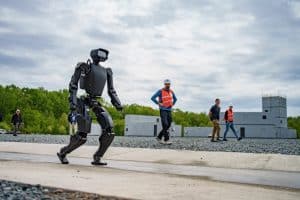
IHMC’s robotics team has just completed an off-site demonstration of its newly developed humanoid robot, Alex.
“Things went really well,” said Senior Research Scientist Robert Griffin. “I believe the Office of Naval Research was impressed by the progress we’ve made over the past 10 months.”
The Office of Naval Research (ONR) awarded IHMC a multi-year and multimillion-dollar contract to develop a robot capable of offsite and outdoor urban operations. The goal for Alex and its successors is to be nimble enough to operate in extreme environments, especially those involving military scenarios and disaster response where the risk for human casualty and injury is extremely high.
“We are designing Alex so it will be able to walk up to a building, open a door, and walk around inside to assess a situation. The first soldier or responder who enters a building or warehouse is at a very high-risk of casualty. With Alex, our robot will be able to enter and assess these hazardous environments where human entry is extremely dangerous,” said Griffin.
Lessons the robotics team gleaned from its work with Nadia have been incorporated into Alex. Nadia is an IHMC humanoid that advanced the robotics field and gained YouTube notoriety for playing ping pong with members of the robotics team. Nadia was a testbed for the structural design of humanoids, from joints to actuators to software that could drive the robot’s behavioral capabilities.
“Alex builds upon years and years of foundational work that our robotics group has been undertaking for more than two decades,” said IHMC CEO Morley Stone. “A confluence of technological advances that have happened on multiple fronts over the past few years have been incorporated into Alex. The combination of these advances have given Alex game-changing capabilities.”
The foundational work Stone refers to began in the mid-2000s when IHMC established its robotics program. It gained notoriety in 2015 when it’s semi-autonomous robot, nicknamed Running Man, brought home $1 million in prize money for placing second in the international DARPA (Defense Advanced Research Projects Agency) Robotics Challenge. That same year IHMC and Running Man appeared on the cover of Time magazine for a story about the epic race to build a humanoid robot.
That was more than 10 years ago, however, and the difference between Running Man and Nadia and now Alex are like night and day, said Stone.
“Even now,” said Stone, “the most advanced competitor humanoids are targeted for the structured environments of warehouses and repetitive tasks that are simple compared to real world environments, especially outdoor environments with changing conditions and the chaos of military operations. So moving robotics out of the lab and into the real world represents a huge step forward for not only IHMC, but all of robotics.”
During the demonstration in Maryland for the Office of Naval Research, Alex successfully walked on rocky gravel, slick surfaces and uneven pavements. “Alex did everything and more that we asked it to do,” said Griffin. “I have to say, even the robotics team was impressed by how well Alex did.”
Latest News
- STEM-Talk: Ken and Dawn tackle listener questions on protein, genetics, resistance training, Moon landings and more
- STEM-Talk: Ken Ford separates what’s real in AI from hype and science fiction
- IHMC’s Morley Stone stepping down; Chief Science Officer Tim Broderick to become new CEO
- STEM-Talk: Dom D’Agostino discusses advances in ketogenic metabolic therapies and hyperbaric oxygen therapies
- IHMC’s new humanoid Alex aces its first off-site, off-tether demonstration
- A Letter From Our CEO
- IHMC project helps pioneer new tools for warfighters
- STEM-Talk: Doug Cooke talks about strengths and flaws of NASA’s Artemis mission
- IHMC hosts national workshop on collaborative autonomy