

STEM-Talk
Episode 197: Scott Sherr discusses hyperbaric oxygen therapy, methylene blue, and more
// Jul 15, 2026
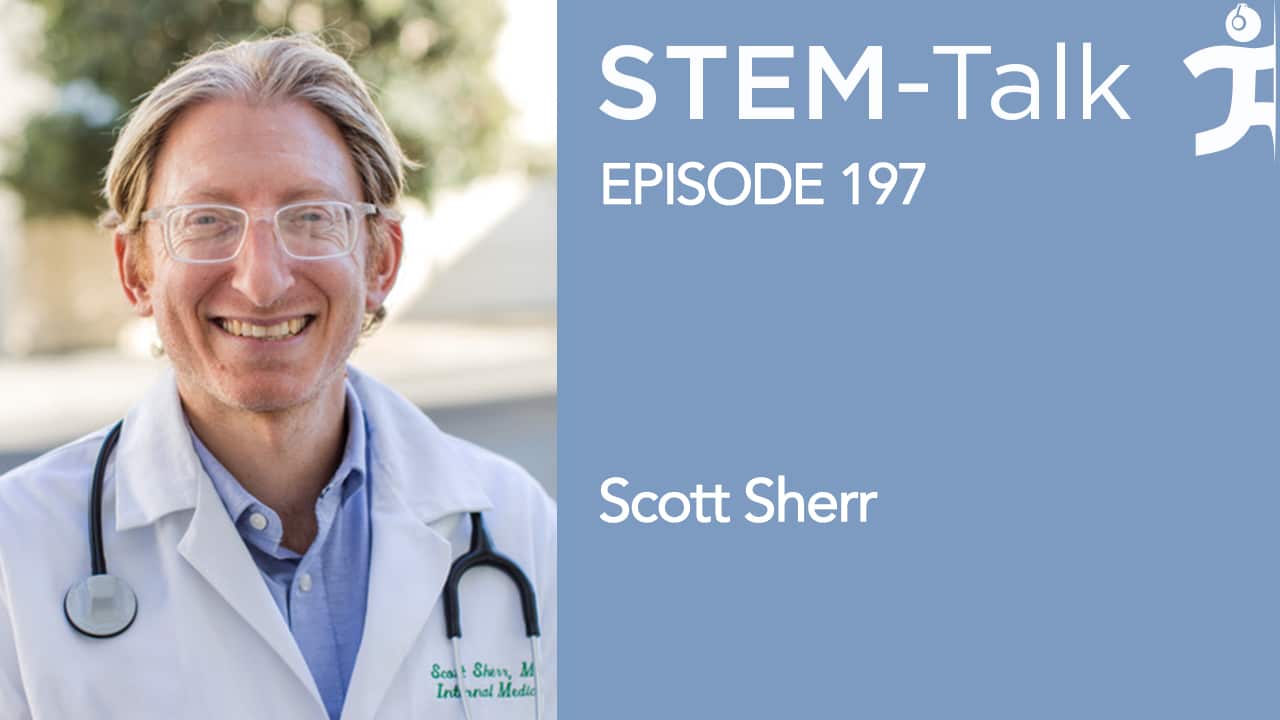









Today we have Dr. Scott Sherr, an internal medicine physician who specializes in Hyperbaric Oxygen Therapy.
Scott is the director of Integrative Hyperbaric Medicine and Heath Optimization at Hyperbaric Medical Solutions. It is a division of Hyperbaric Medical Solutions, an independent, hyperbaric oxygen therapy provider that aims to educate people about the benefits of hyperbaric oxygen therapy via telemedicine consulting. He also is COO of Troscriptions, which provides physician-formulated products including popular methylene blue products.
In today’s interview, Scott talks about how he uses Hyperbaric Oxygen Therapy (HBOT) to treat a number of health conditions. He also shares how he incorporates methylene blue into some of his treatment strategies and explains how HBOT is now being used as a complementary treatment for autoimmune diseases by helping reduce inflammation, improve blood flow and support immune function.
Show notes:
[00:03:29] Dawn tells Scott that she heard a story that Scott had his spine adjusted when he was just five minutes old. She asks Scott if he can share what happened. [00:04:15] Dawn mentions that Scott grew up in New York on Long Island and that as a child he spent a lot of time at his father’s chiropractic office. Dawn asks Scott about his father and his practice. [00:05:38] Ken notes that Scott was into sports as a kid and asks him to talk about his childhood and what he was like as a kid. [00:07:09] Dawn notes that after high school, Scott left New York for the West Coast, landing at UCLA. Dawn asks Scott to talk about what led him there. [00:08:00] Dawn explains that Scott initially started to major in biology but quickly changed majors. Scott explains why he changed majors. [00:08:41] Dawn asks Scott why he chose to attend the University of Maryland for medical school after graduating from UCLA. [00:09:26] Dawn asks Scott about the story of how he met his wife at the University of Maryland. [00:09:50] Dawn pivots back to Scott’s love of music, mentioning that Scott and three other medical school students at Maryland formed a band called The Airport Rocking Chairs. Scott describes how the band came together and how they performed at gigs around the Baltimore/D.C. area. [00:11:16] Ken asks Scott to talk about how his early ambition upon entering medical school was to find a way to bridge the gap between conventional and alternative/chiropractic medicine. [00:12:54] Ken explains that in Scott’s third year of medical school, he did rotations at the University Shock and Trauma Facility. Ken asks Scott to talk about why this was such an important experience for Scott. [00:14:32] Dawn explains that hyperbaric chambers are used to treat injuries like necrotizing fasciitis and severe wounds. Dawn asks Scott to talk about finding a hyperbaric chamber in the basement of the University Shock and Trauma Facility and how that led to his fascination with the potential for hyperbaric oxygen therapy. [00:15:51] Dawn asks Scott to talk about how his initial research on hyperbaric therapies led him to conclude that they were being vastly underutilized in conventional medicine. [00:16:31] Dawn mentions that people are likely familiar with hyperbaric oxygen therapy (HBOT) in terms of treating divers suffering from decompression sickness. She asks Scott to give a primer on the mechanisms by which HBOT affects the body and why it has potential to treat other conditions besides decompression sickness. [00:19:38] Ken asks Scott to talk more about other conditions, both acute and chronic, that HBOT might be helpful in treating. [00:22:51] Dawn asks about Scott’s experience as a hospitalist, which is an internal medicine physician who acts as a primary care physician in a hospital, and how this experience gave him a unique perspective on the strengths and limitations of modern medicine. [00:25:13] Ken asks Scott if it’s fair to say that his experience as a hospitalist was foundational in developing his understanding of patient care and healthspan. [00:26:51] Dawn explains that when Scott’s wife received a fellowship at Stanford University, Scott eventually left his career as a hospitalist to serve as the medical director for a hyperbaric medicine facility in the San Francisco Bay area. Dawn asks Scott to talk about how this experience deepened his understanding and expertise in hyperbaric oxygen therapy. [00:28:26] Ken asks Scott to talk about his relationship with Dominic D’Agostino, who was our recent guest on STEM-Talk episode 196, and who is very active in the field of hyperbaric oxygen therapy. [00:30:48] Dawn mentions that during Scott’s work as a hospitalist, he began to develop a more integrated approach to hyperbaric medicine, taking nutritional status, sleep patterns, mitochondrial function, and a number of other factors into consideration. Doing this work, Scott noticed that a number of patients would require weeks or months of preparation before beginning HBOT, contrary to the status quo of the time. Dawn asks Scott to talk about his insights and how this experience changed his views on medicine. [00:33:19] Dawn asks Scott to talk about the evolution of his work in developing an integrative hyperbaric medicine model and how he caught the attention of HBOT practitioners around the world. [00:35:21] Ken notes that interest in hyperbaric oxygen therapy has grown substantially in the last 20 years and goes on to mention that a particularly promising application of HBOT is as a complementary treatment for autoimmune diseases, being shown to reduce inflammation, improve blood flow and support immune function. Ken asks Scott to talk in depth about HBOT in the context of autoimmune disease treatment. [00:39:13] Following up on Scott’s mention of epigenetic changes following HBOT, Ken asks if this has been directly measured and if so, how long are these changes sustained. [00:41:14] Dawn asks Scott about the potential for HBOT to be used for athletes looking to speed up their recovery times from injuries. [00:43:19] Dawn asks Scott if there are certain populations who should avoid HBOT. [00:46:27] In order to optimize HBOT, Dawn explains that Scott works with people to tailor their treatment to their individual needs and asks Scott to walk listeners through how this process works in practice. [00:50:00] Ken notes that most HBOT studies describe dosages of HBOT in terms of oxygen concentration, oxygen pressure and number of sessions. He asks Scott how he defines a “dose” biologically and what metrics he uses to tell whether a patient has received enough treatment to induce durable change? [00:53:40] Ken asks Scott if his experience treating patients has informed him on different characteristics that can predict whether a patient will have a robust response to HBOT. [00:56:01] Dawn mentions that the benefits of HBOT are often explained in terms of either improved oxygen delivery or improved mitochondrial signaling and neuroplasticity. Dawn asks Scott what mechanisms are most important in the context of chronic neurological disease. [00:58:04] Dawn asks Scott for his thoughts on the hyperoxic-hypoxic paradox (HHP) as an explanation of HBOT-induced adaptation. [01:00:28] Ken asks Scott if he could only measure three variables before and after HBOT treatment, what would they be. [01:03:43] Ken goes on to asks Scott what he sees as the most important unanswered question in HBOT today. [01:06:22] Dawn mentions that in 2017 Scott met Dr. Ted Achacoso, who is the founder of Health Optimization Medicine. Dawn asks Scott to explain how Ted introduced him to a fundamentally different framework for understanding health. [01:10:08] Circling back to the topic of bridging the gap between conventional and alternative medicine, Dawn mentions that Scott has become part of a practice that isn’t afraid to tap into therapies that break from conventional medicine. As an example, Dawn explains that Scott sometimes integrates psychedelic therapy with HBOT. Dawn asks Scott to talk about the framework he uses, combining HBOT with psychedelic therapy. [01:13:56] Ken mentions that Scott also incorporates methylene blue into some of his treatment strategies, Ken directs listeners interested in learning more about how methylene blue can improve cognitive function and energy production to listen to STEM-Talk episode 191 with Francisco Gonzalez-Lima. Ken asks Scott to talk about his use of methylene blue in his practice. [01:20:15] Dawn asks Scott where people can go to learn more about him and his practice. [01:22:33] Ken asks Scott if he has any new projects looming on the horizon. [01:23:54] Dawn closes our interview with Scott by asking if he still plays guitar and if his old band The Airport Rocking Chairs have any plans for a reunion.Links: