

Investigating exercise’s potential to reverse hallmarks of aging
 What if you could reduce risk of mortality from any cause by 13, 26, or 39 percent?
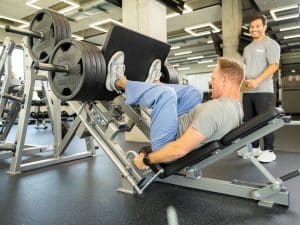
Researchers at IHMC think it’s not only possible, but well within reach of people in their sixties who are willing to invest in three days a week of combined endurance exercise training and resistance training.
As people age and reach their sixties, their risk of all-cause mortality spikes. Seniors are more susceptible to deaths from heart disease, strokes, cancer, dementia, and traffic accidents. Plus, as people age and allow themselves to become frail, they are more susceptible to accidental falls, which are the leading cause of injury-related death among people 65 and older, according to the Centers for Disease Control and Prevention.
Dr. Marcas Bamman and his colleagues at IHMC are in the midst of a NIH-sponsored clinical trial that’s designed to demonstrate exercise’s potential to slow down and even reverse the hallmarks of aging that contribute to all-cause mortality. Called Multidimensional Modeling to Maximize Adaptations to Exercise (M³AX), the clinical trial is in the third year of a five-year study that aims to provide evidence of exercise’s ability to improve the healthspan and quality of life of people over 59 years old.
But what if adding a nitrate supplement to an older adult’s endurance and resistance training could help further reduce the risk of all-cause mortality as well as reverse the hallmarks of aging?
That’s the question IHMC is now investigating in a new NIH study that will be a randomized, double-blind placebo-controlled trial called BOOST-X.
Bamman, who is a Senior Research Scientist at IHMC and Director of Healthspan, Resilience and Performance Research, says that BOOST-X is also an exercise trial like M³AX, but with the addition of what Bamman refers to as an adjuvant, which is why the trial is called BOOST-X.
“We are adding a nitrate supplement as a boosting agent to help people who are kind of slow out of the gate to adapt to exercise in a way that will improve their vascular and cardiorespiratory function. Older adults sometimes synthesize lower levels of nitric oxide, which is important for dilating blood vessels. Older adults who have stiff arteries experience a lot of age-related changes that result in reduced blood flow to different parts of the body. If you can impact the ability for blood vessels to relax and dilate, you can deliver more blood to the muscles, to the brain, and all other the body parts.”
Bamman says to think of it as a garden hose. “Compared to a half-inch garden hose, a larger three-quarter-inch garden hose increases flow rate. So providing something that helps blood vessels dilate enables more blood to flow throughout the body while also helping regulate blood pressure.”
As principal investigator of the trial, Bamman and IHMC have partnered with two other campuses, the University of Colorado in Boulder and the University of Maryland College of Medicine in Baltimore. By conducting the study across three sites in different parts of the country, researchers will be able to demonstrate that the clinical trial results aren’t just unique to Pensacola.
“When you conduct a multi-site trial like this, you have a much higher impact on clinical care and on science. In single-site studies, people will look at the results and say, ‘Oh, that’s kind of a cool result on people in Pensacola.’ But if you have a result that repeats itself in other regions of the country, the potential for impact on healthcare is much greater.”
This study aligns with the driving premise behind the focus of Bamman’s research over the years, which is that that exercise is a potent form of medicine. Over a 30-year career, Bamman has been involved in studies and clinical trials around the world that have demonstrated the ability of exercise to improve human healthspan.
If you’re providing something that helps the vascular system improve its ability to deliver blood and nutrients and clear out waste products, it’s not just improving your skeletal muscles, but also the heart, the liver, the brain, the kidneys. It’s improving all your organs. And improving a person’s cardiorespiratory fitness through exercise is the most potent way to do this,” says Bamman.
“So with this study, we want to see improvements across the board, including cognitive function,” he adds. “And by adding the nitrate adjuvant, which has already been shown to improve cognitive function in older people but has never been tested in conjunction with high-intensity exercise, we suspect we will see an even bigger boost in people’s cognitive function.”
Two of the most popular ways to dilate blood vessels and encourage more blood to flow through the body are with a capsule or a drink with a nitrate supplement. Beets, says Bamman, have a high concentration of nitrate. In the BOOST trial, researchers will be using a beet-root juice.
“We are partnering with a company in the United Kingdom that produces the nitrate-rich beet root juice as well as a matched placebo,” says Bamman. “So this trial is double-blind and placebo controlled. Half of the study participants are going to be on the nitrate supplement and half are going to be on a placebo that tastes and looks the same. Nobody will know if they are taking the actual nitrate supplement or the placebo.”
Bamman believes the addition of the nitrate supplement will help enhance some of the healthspan adaptations people experience as a result of exercise. In addition to enhancing blood flow, he believes the combination of exercise and the adjuvant will improve mitochondrial function, reduce inflammation and lower oxidative stress. “These are important additional health benefits if they prove to be true.”
In the M³AX trial, which is in year three, Bamman and his colleagues are seeing clinically important and significant improvements in cardiorespiratory fitness and functional muscle quality in most of the study participants, but not in all of the participants. By adding the adjuvant supplement in the BOOST-X trial, researchers think even more study participants will experience significant improvements in these and other important health outcomes.
“It’s really all about the aging cardiovascular system,” says Bamman. “As our tissues become older, we reduce the number of small vessels, which are called arterioles and capillaries, which feed the different tissues in our bodies. So if you think of a tree, it has a bunch of branches on it. But as the tree grows older, some of those branches fall off. It’s the same thing in our bodies. As we get older, some of the branches of the vascular tree fall off and restrict blood flow.”
Because cardiorespiratory fitness is one of the most powerful and potent predictors of all-cause mortality, the body needs strong blood vessels and a high VO2 max. VO2 max is the maximum rate of oxygen consumption a person’s body can achieve during intense exercise. It is closely related to the efficiency of blood vessels in transporting oxygen to muscles. Improved blood vessel function enhances oxygen delivery, which can lead to a higher VO2 max and better overall fitness.
“If you have a low VO2 max, you’re in trouble. If you have a high VO2 max or you’re improving your VO2 max, the impact on reducing risks of cardiovascular disease and all-cause mortality is actually pretty amazing,” says Bamman, “Even a small increment of improvement in your VO2 max, which we call a MET, is significant.”
MET stands for metabolic equivalent, and one MET approximates a person’s resting metabolic rate. The ability to achieve higher MET levels during exercise indicates better fitness and lower risk of cardiovascular problems. Just one MET of improvement in your VO2 max lowers risk of all-cause mortality 13 percent.
“In the M³AX trial, we are seeing some of the study participants improve their VO2 max by two METS. So that means a 26 percent reduction in risk of all-cause mortality. That’s a big impact,” says Bamman.
For people who are not in the science or biomedical field, Bamman thinks the analogy of a tree and its branches makes sense. “You have an old tree and the branches start falling off. Which branches fall off? Some of the big ones, but mostly the small ones. Think of all those as blood vessels. Let’s restore the tree and actually encourage the tree to grow and branch more. That’s the idea.”
To learn more about the M3AX trial and to consider participating, recruitment is ongoing with more information click on the link below:
Recruitment for participation in the BOOST-X trial is expected to begin in late December 2026. Check the IHMC Study Participation website for future updates: https://www.ihmc.us/study-participation/
Latest News
- Centering the Human in AI Decision Making
- Investigating exercise’s potential to reverse hallmarks of aging
- Alex wins Army’s xTechHumanoid competition
- STEM-Talk: Is AI out of control? Could it kill humanity? Ken Ford discusses the real and imagined risks of AI
- STEM-Talk: Ken and Dawn tackle listener questions on protein, genetics, resistance training, Moon landings and more
- STEM-Talk: Ken Ford separates what’s real in AI from hype and science fiction
- IHMC’s Morley Stone stepping down; Chief Science Officer Tim Broderick to become new CEO
- STEM-Talk: Dom D’Agostino discusses advances in ketogenic metabolic therapies and hyperbaric oxygen therapies
- IHMC’s new humanoid Alex aces its first off-site, off-tether demonstration