

Alex wins Army’s xTechHumanoid competition
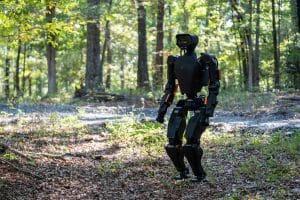 IHMC and its humanoid robot Alex won the demonstration stage of the U.S. Army’s xTechHumanoid competition that was held at the Marine Corps Base Quantico in Virginia.
More than a hundred companies and institutes submitted proposals for the opportunity to demonstrate their humanoid technology to the U.S. military. Based on the papers that were submitted, the Army selected 10 organizations to travel to Quantico to demonstrate the capabilities of their humanoid robots.
IHMC’s Alex stood out for its hybrid autonomy, which combines AI decision-making with human-operator control to perform complex missions. IHMC and four other organizations now advance to a structured evaluation phase where they will further demonstrate how their technologies can operate in complex environments that would otherwise put humans at risk. The final phase also includes an opportunity to secure a prototype evaluation contract with the U.S. Army.
“It was great that out of more than 100 submissions we were selected as one of the top 10,” said Robert Griffin, a Senior Research Scientist who leads IHMC’s robotics group. “And, of course, we are all thrilled that we won the finals of the competition. Now we move on to an evaluation stage where we get to show how Alex is being designed to overcome significant obstacles and operate in environments where there will be high degrees of uncertainty.”
The Army structured the xTechHumanoid competition as a way for the military to gain a better understanding of what humanoid technology can currently do and, thus far, can’t do. The military’s overall goal is to eventually use humanoids to perform physically demanding tasks and reduce soldiers’ exposure to life-threatening situations.
Griffin emphasizes that the goals of IHMC’s robotics team is not to develop autonomous weapons, but to create systems capable of performing dangerous tasks while keeping humans out of harm’s way. “We are not designing Alex to make active combat decisions or to do things like exercising force. We are designing Alex to be able to move from cover to cover between buildings and withstand enemy fire so a soldier won’t have to. For example, if a humanoid needs to find something like an IED in a building, the humanoid will need to be able to get into that building and move around in a building it has never been in before. It may have to get into that building through a door or a window or breach the door with a kick. It may have to move furniture out of the way to search for the IED. We are designing Alex to do all this and reduce a soldier’s exposure to danger.”
IHMC’s win at the xTechHumanoid competition comes on the heels of a successful demonstration Alex made earlier this year for the Office of Naval Research (ONR). The demonstration featured an untethered Alex walking over gravel and along slippery and uneven surfaces. The design and development of Alex is a multi-year, multimillion dollar project that’s being funded through the ONR.
“Alex’s abilities have come a long way in the past year,” said Griffin. “But there is still so much more that we need to work on. The good thing about the xTechHumanoid competition and our demonstration for ONR is that they showed us we are on the right track.”
Latest News
- Alex wins Army’s xTechHumanoid competition
- STEM-Talk: Is AI out of control? Could it kill humanity? Ken Ford discusses the real and imagined risks of AI
- STEM-Talk: Ken and Dawn tackle listener questions on protein, genetics, resistance training, Moon landings and more
- STEM-Talk: Ken Ford separates what’s real in AI from hype and science fiction
- IHMC’s Morley Stone stepping down; Chief Science Officer Tim Broderick to become new CEO
- STEM-Talk: Dom D’Agostino discusses advances in ketogenic metabolic therapies and hyperbaric oxygen therapies
- IHMC’s new humanoid Alex aces its first off-site, off-tether demonstration
- A Letter From Our CEO
- IHMC project helps pioneer new tools for warfighters