

STEM-Talk
Episode 192: Ken and Dawn weigh in on ChatGPT, ketamine, urolithin-A, rapamycin, and more in wide-ranging AMA
// Mar 5, 2026
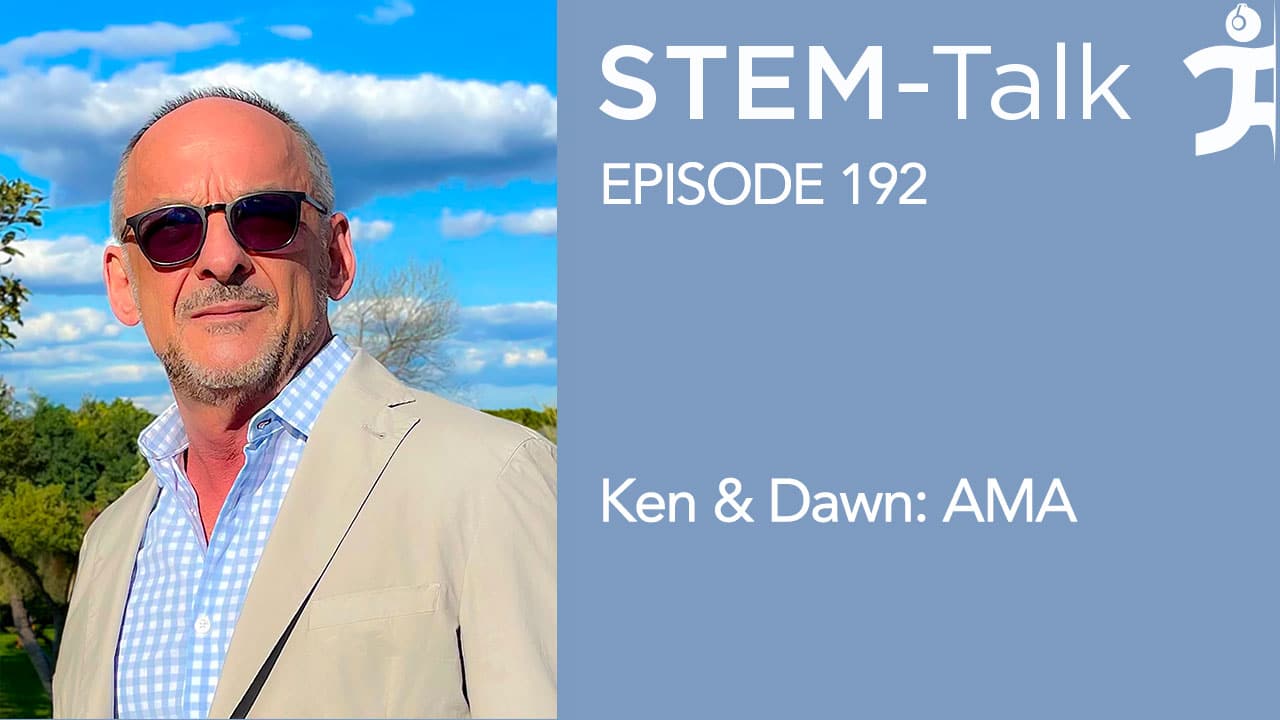









ChatGPT has been in the news a lot lately and, as a result, quite a few STEM-Talk listeners have tossed us questions about the reliability and limitations of generative-artificial intelligence chatbots as well as large-language models more broadly. Ken and Dawn tackle this question and a number of others in today’s Ask Me Anything episode.
We have listeners wondering why astronauts train in underwater conditions for spacewalks; icebreakers in antarctica; the value of supplementing with urolithin-A; and the effectiveness of L-citrulline in helping aging blood vessels.
Ken also weights in on questions related to lithium deficiency and the onset of Alzheimer’s disease; a study that found mTOR activation may not be necessary for ketamine’s beneficial effects in the context of depression; and a paper that demonstrated short-term mTOR inhibition by rapamycin improved cardiac and endothelial function in older men.
Show notes:
[00:02:49] Ken opens our AMA with a listener question for Dawn, which asks why, despite the differences between diving and zero-gravity environments, why do astronauts train in underwater conditions for spacewalks. The listener goes on to mention an article they read about NASA’s neutral buoyancy lab in Houston, which contains a partial replica of the International Space Station. [00:07:42] A listener asks Ken if he is still optimistic about the value of supplementing with urolithin-A, and if so, is there a brand he recommends. Ken mentions episodes 118, with Julie Anderson, and 173, with Anurag Singh. Ken also discusses a paper titled “Effect of the mitophagy inducer urolithin A on age related immune decline, a randomized placebo-controlled trial” co-authored by Anurag. Ken also mentions clinical research supporting the urolithin-A supplement Mitopure. [00:10:53] A listener asks Ken about a paper titled “Short-term mTOR inhibition by rapamycin improves cardiac and endothelial function in older men: a proof-of-concept pilot study.” [00:14:29] Ken discusses a 2020 paper from a research group at Yale, which suggested that mTOR activation may not be necessary for ketamine’s beneficial effects in the context of depression. The paper also reported that m-TOR suppression via rapamycin might prolong ketamine’s antidepressant effects. [00:18:47] A research scientist formerly working in Antarctica asks Ken about Russia’s dominance in the realm of ice breakers. [00:23:55] A listener mentions that for some people, when they used ChatGPT to ask about the assassination of political commentator Charlie Kirk, ChatGPT sometimes responded by denying the assassination occurred. The listener asks Ken about the credibility and reliability of generative AI and large-language models. [00:28:49] Several listeners have submitted questions for Ken regarding a paper published in Nature in August of last year titled “Lithium deficiency in the onset of Alzheimer’s disease.” Ken gives his thoughts on this paper. [00:31:56] For our final question this AMA, a listener asks Ken about the arginine paradox, which regards L-arginine, which is used by the body to make nitric oxide, which is necessary to relax and maintain flexibility of blood vessels. However, several papers have reported that supplementation of arginine does not reliably improve aging blood vessels. In contrast, recent research suggests that L-citrulline might be more effective. The listeners sent questions asking about the possible effects of citrulline in vascular health and aging.In his answer, Ken cites the following papers:
— Citrulline regulates macrophage metabolism and inflammation to counter aging in mice.
If you have questions for Ken and Dawn after listening to today’s episode or any episode of STEM-Talk, please email our producer, Randy Hammer, at rhammer@ihmc.org.
Links: