

STEM-Talk
Episode 191: Francisco Gonzalez-Lima discusses methylene blue & noninvasive human brain stimulation
// Jan 30, 2026
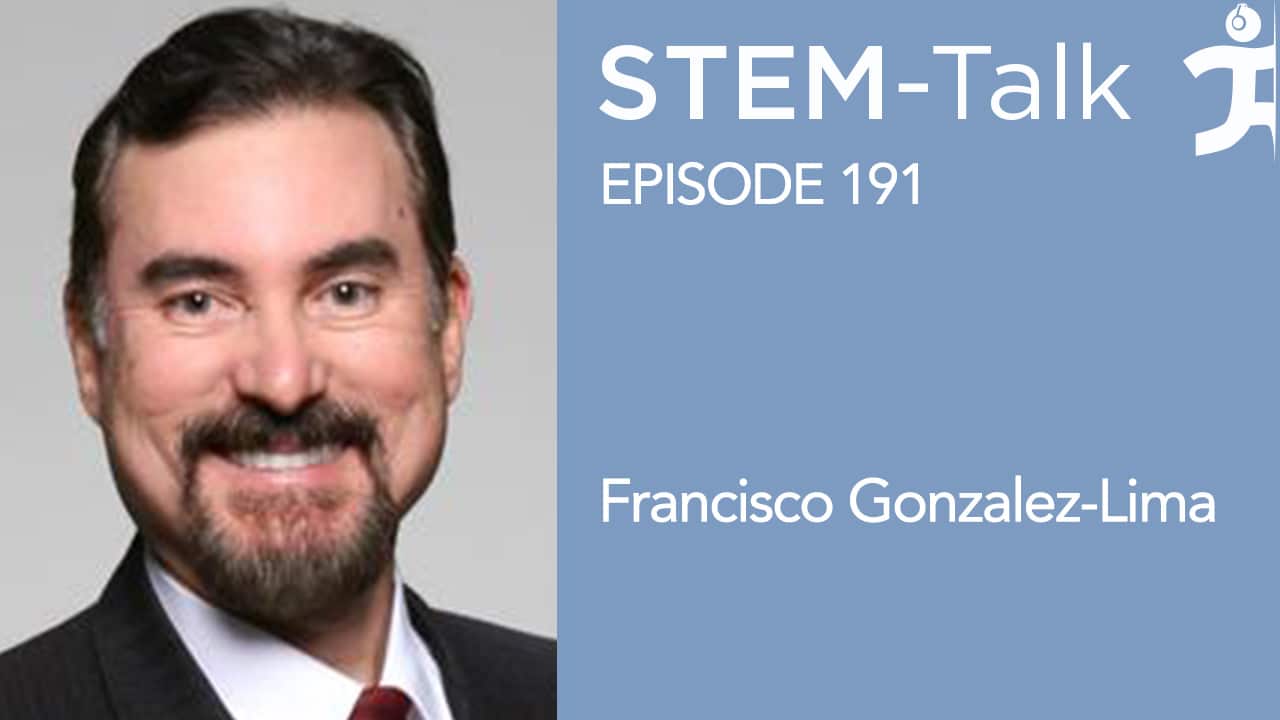









Today we have Dr. Francisco Gonzalez-Lima, a behavioral neuroscientist who was our guest in episodes 106 and 107 back in 2020.
Since those 2020 interviews, Francisco and his colleagues at the Gonzalez-Lima Lab have produced dozens of more studies and papers that have advanced their work on methylene blue, transcranial lasers, memory enhancement, neuroprotection and neurocognitive disorders.
Francisco and his lab at the University of Texas Austin are recognized as world leaders for their research on the relationships between brain energy metabolism, memory and neurobehavioral disorders.
In today’s interview, we talk to Francisco about his lab’s most recent research on the beneficial neurocognitive and emotional effects of noninvasive human brain stimulation in healthy, aging and mentally ill populations. This research primarily uses transcranial infrared laser stimulation and multimodal imaging, which we will discuss in today’s interview.
Be sure to check out our earlier interviews with Francisco where he talked aobut his work on brain metabolic mapping and Alzheimer’s, episode 106, and his research into methylene blue and near-infrared light as therapies for cognitive disorders, episode 107.
Show notes:
[00:04:32] Dawn and Ken open our interview with Francisco by mentioning that his lab has been very productive pursuing new research avenues since he was last on STEM-Talk. Ken mentions that Francisco has recently begun collaborating with his sister who has a PhD in computational and applied mathematics and asks Francisco to talk about the work they’re doing together. [00:06:21] Dawn shifts to talk about the roadblocks that Francisco and his team have been dealing with, particularly that the review process for academic papers is unusually slow, not just for Francisco’s team but at large. Dawn asks Francisco to discuss this issue. [00:10:37] Dawn recaps that in our previous interview with Francisco in 2020, the discussion focused on his research into methylene blue, which has been primarily used to treat methemoglobinemia, however, the potential for methylene blue to treat declining cognitive function is an active area of research. Despite Francisco’s successful work with methylene blue, he often gets asked about its safety, largely due to various misconceptions. Dawn asks Francisco to talk about the misconceptions about methylene blue. [00:14:57] Ken asks if Francisco what some other misconceptions about methylene blue are. [00:20:43] Given the discussion of dosing, Ken asks Francisco what the safe dose range is for methylene blue in humans. [00:28:15] Ken mentions an article published a few months ago titled “Beyond plaques: How methylene blue and ketones address vascular hypometabolism in Alzheimer’s disease” Ken goes on to mention that the article did a good job of summarizing Francisco’s work as well as the work of Steve Cunnane, who was our guest on episode 59. Ken asks Francisco to discuss his thoughts on the article. [00:34:25] Dawn shifts focus to discuss Francisco’s work on photobiomodulation, specifically transcranial infrared laser stimulation, which is a non-invasive method for neuroprotection and cognitive enhancement. Dawn explains that Francisco has written two chapters on this topic that summarizes his work in the area, one of which appeared in the Oxford handbook on transcranial stimulation, and the other is in a book on augmentation of brain function, based on a series of presentations he gave in Switzerland. Dawn asks Francisco to give a broad overview of his work on photobiomodulation and transcranial infrared laser stimulation. [00:43:52] Ken asks Francisco to talk about a paper titled “Light buckets and laser beams” that he and other researchers composed after attending a photobiomodulation workshop convened in 2023 by the director of the National Institute on Aging and several NIH lab directors. [00:51:25] Ken asks Francisco if there are any commercially available photobiomodulation devices that he thinks have substantial utility. [00:56:27] Ken asks Francisco to discuss mitochondrial disfunction in the context of neurodegeneration and his work on targeted stimulation of the mitochondria with photo biomodulation. [01:06:58] Ken asks Francisco to talk about the potential benefits of photobiomodulation on the aging process outside of neurodegenerative conditions. [01:17:16] Dawn mentions that transcranial infrared stimulation stimulates prefrontal energy metabolism and oxygenation, which produces cognitive enhancing effects. Dawn goes on to ask Francisco about his recent paper exploring this phenomenon in the context of depression titled “Augmenting internet based cognitive behavioral therapy for major depressive disorder with transcranial infrared laser stimulation.” [01:23:08] In light of the promising results of this study, Ken asks Francisco what he sees as the next research step to further this progress. [01:30:15] Ken comments on how Francisco has not only had great accomplishments in his recent research but also has a lot of fruitful opportunities ahead. [01:31:07] Ken asks Francisco if he has looked at photobiomodulation in combination with transcutaneous vagal nerve stimulation. [01:34:28] Ken mentions that for listeners interested in learning more about vagal nerve stimulation they can listen to episodes 179 with JP Erico, and 172 with Kevin Tracey. Francisco discusses the difficulty in knowing whether to attribute effects of vagus nerve stimulation to stimulation of the vagus nerve itself or incidental stimulation of the carotid artery … or some combination. [01:38:33] Ken mentions that Francisco is now trying to move away from animal studies and focus more on human studies. Ken asks what human trials he is hoping to conduct. [01:42:27] Dawn closes our interview thanking Francisco for once again joining us on STEM-Talk.Links: