

IHMC studies the potential of exoskeletons to reduce the biomechanical injuries shipyard workers face
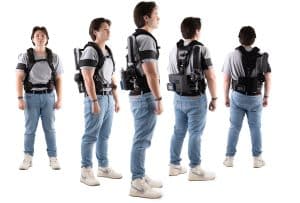
When Jared Li started to study shipyard workers, he didn’t know much the work they did on a daily basis, except that the work was heavily manual and required working through tight and hazardous spaces. He also noticed that much of the work involved bending, lifting, and holding tools for extended periods of time (welding, drilling, grinding, etc.), especially with arms outstretched.
Li, who leads the exoskeleton research at IHMC, wondered if exoskeletons might be a good fit for shipyard workers. Li’s work is focused on finding real-world applications for the technology.
“It became clear to me that the shipbuilding industry was heavily affected by overuse injuries,” said Li. “I started thinking that perhaps the work we do with exoskeletons here at IHMC might be able to ease some of the biomechanical issues the workers face. Just imagine someone who is holding up their arms and welding long periods of time. That puts a lot of strain on the shoulders and the back – so a shoulder-focused exoskeleton could probably help offload that strain on the shoulder muscles. At least, that was my thinking.”
So, Li reached out to Austal USA, a subsidiary of the Australian-based shipbuilding company Austal that designs and constructs commercial ships as well as vessels for the U.S. Navy. One of the company’s three major ship-building facilities is located an hour away from IHMC in Mobile. A month after his phone call to the offices in Mobile, Erik Bjorkner, Senior Manager Systems Engineering and Technology for Austal USA, returned Li’s call.
Since then, the two have formed a partnership in trying to find ways of applying exoskeletons and other robotic technologies to the shipbuilding profession. Together, and support from Garry Shields, Director of the Disruptive Technologies Lab at the Naval Surface Warfare Center Carderock Division, the team submitted a proposal to the National Shipbuilding Research Program (NSRP) and were awarded a grant to study the underlying biomechanics of shipbuilding tasks and how exoskeletons might be able to alleviate some of the biomechanical strain that workers have to endure.
The NSRP is a collaborative effort of the U.S. shipbuilding industry and the U.S. Navy to research, develop and implement shipbuilding technologies to enhance the capabilities of commercial ships and U.S. Naval vessels. Over the next several months, Li and other IHMC staff members will conduct a study to understand the biomechanical effects of shipbuilding and how off-the-shelf exoskeletons assist the work. They will also travel regularly to Austal in Mobile to embed with their workforce to directly understand the challenges the workers face. Then Li and his team will start outfitting Austal workers with the exoskeletons to test.
“Our goal is to see if the workforce can accept these devices and whether the workers perceive any benefit from using them.,” said Li. “In the beginning, we’re going to study a shoulder exoskeleton and a back device. We’re also in the process of purchasing a hybrid back-shoulder device to see if there is a catchall solution that can help with most of the tasks that are done in shipyards. While these devices are likely be successful, I suspect we will find some gaps in effectiveness between each device. At that point, we will start developing our own wearable that can fill these gaps and be more applicable and helpful as well as custom-tailored to the work that is done in shipyards. I believe we’ll be able to reduce injury risk as well as workers’ comp. expenditures in the future”
Li sees exoskeletons as having the potential to reduce the amount of general strain shipyard workers experience during the day. One of the biggest problems the shipbuilding industry faces is rework. Many of the mistakes made during welding and other tasks in the manufacturing phase of shipbuilding can be attributed to fatigue. As Li points out, when a person’s body fatigues from heavy manual work during an eight-hour shift, their ability to focus and do tasks well degrades and leads to mistakes.
“The main thing I’m interested in is trying to help people who need it. A shipyard worker should not get home at the end of the day and feel like they’re completely drained. It’s really unfortunate that millions of people get done with their jobs and have no energy for recreational hobbies or their families. I really believe the work we do with exoskeletons here at IHMC can help with that.”
Latest News
- Investigating stress-induced mitochondrial dysfunction and its role in systemic health
- IHMC studies the potential of exoskeletons to reduce the biomechanical injuries shipyard workers face
- A Q&A With IHMC’s new CEO, Dr. Timothy Broderick
- Centering the Human in AI Decision Making
- Investigating exercise’s potential to reverse hallmarks of aging
- Alex wins Army’s xTechHumanoid competition
- STEM-Talk: Is AI out of control? Could it kill humanity? Ken Ford discusses the real and imagined risks of AI
- STEM-Talk: Ken and Dawn tackle listener questions on protein, genetics, resistance training, Moon landings and more
- STEM-Talk: Ken Ford separates what’s real in AI from hype and science fiction