

A Q&A With IHMC’s new CEO, Dr. Timothy Broderick
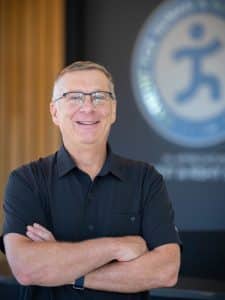
In October, when Dr. Timothy Broderick took over as IHMC’s new CEO, he became just the third person to hold the CEO title since IHMC’s founding in 1990.
Broderick took over for Dr. Morley Stone, who stepped away as CEO to lead an Air Force spin-out company he helped found, Mined XAI. Stone replaced Dr. Ken Ford, IHMC’s founder wh
o spent 34 years as the institute’s leader and CEO before transitioning into an emeritus role.
Broderick is hardly new to IHMC. He joined the institute eight years ago as Chief Science Officer and Senior Research Scientist, to shape research strategy and lead high-impact research
focused on enhancing human health and performance in extreme environments.
His path to IHMC- and now to its top leadership position- has not been a straight line.
A practicing academic surgeon by training, Broderick has spent much of his career working at the convergence of medicine, science and emerging technologies. Before joining IHMC, he served as a program manager at the Defense Advanced Research Projects Agency (DARPA), where he conceived and established biotechnology programs focused on the diagnosis and treatment of military-relevant disease and injury. Earlier, he served as program manager at the U.S. Army Medical Research and Materiel Command’s Telemedicine and Advanced Technology Research Center.
Throughout his career, Broderick has worked across fields – surgery, computer science, simulation, robotics, and human performance. His research has taken him ab
oard NASA’s KC-135 parabolic laboratory and beneath the ocean as part of NASA’s Extreme Environment Mission Operations (NEEMO) program, where he helped develop advanced surgical technologies for long-duration spaceflight.
That willingness to cross traditional boundaries — and to explore what becomes possible when different disciplines and technologies converge — is a natural fit for IHMC.
Below, Dr. Broderick talks about what drew him to the institute, what he has learned along the way and where he sees IHMC going next.
What most excites you about becoming CEO of IHMC?
I’ve spent much of my career at the convergence of disciplines and forefront of technologies. I’ve often been a square peg in a round hole, and that has served me well. It has taught me to look across disciplines and recognize possibilities that may not be obvious when you stay within the boundaries of just one. This makes IHMC a natural fit for me.
We have tremendous strength in AI and robotics, and now we’re building significant capabilities in healthspan, resilience and performance. What is especially exciting is what happens when these areas converge. There are very few research institutions with the breadth, people and culture to research effectively at these particular intersections.
IHMC has an extraordinary 36-year history, and I feel a tremendous responsibility to build on that foundation. But I’m equally excited about what comes next — expanding our collaborations, pursuing new areas of applied research and making sure the work we do continues to be distinctive, relevant and impactful.
You arrived at IHMC eight years ago as the Chief Science Officer. What drew you to the institute?
While I took a somewhat circuitous path to get here, there has been a consistent thread throughout my career. I’ve always been interested in the places where established disciplines meet and teaming enables something new to become possible.
When I began combining computer science with medicine, things like telemedicine were far from mainstream. Later, my work took me into surgical robotics and telesurgery
– and then evolved into biotechnology and human performance. I’ve been comfortable moving into different areas and bringing ideas from one into another.
That is very much part of the culture at IHMC. Researchers here have the freedom to ask interesting questions and pursue ideas that don’t fit neatly within the boundaries of a single discipline.
When I came here, IHMC was already doing exceptional work in areas like human-centered AI and robotics. I saw an opportunity to bring my own experience to bear and work with IHMC researchers to advance the human condition.
What is the message you want to send about what people can expect from you as CEO?
First, I understand the responsibility that comes with leading an institution like IHMC. We have a remarkable history, a strong culture and longstanding support from the people of Pensacola and state of Florida. Preserving those strengths is important.
At the same time, IHMC is pivoting to respond to changes in federal research priorities, and we are seeing success in attracting funding for applied research in areas such as AI, robotics, and aging.
Though I have been with IHMC for 8 years, as CEO, it is important to connect the dots from our past to our future. With that in mind, I plan to spend time listening, visiting teams, and working toward a well-defined shared vision. One that enables us to anticipate where science, technology and research needs are moving rather than simply responding to where they are today.
That means continuing to differentiate what we do. We don’t want to do the same robotics, AI or human performance research everyone else is doing. We want to identify hard problems where IHMC’s particular combination of people, expertise and capabilities allow us to make distinctive contributions.
That also means making sure IHMC remains a robust and resilient organization – ensuring that our researchers have the environment and resources they need to do exceptional work.
Over the years, IHMC has mostly worked with federal agencies like DARPA, the Office of Naval Research and the Air Force Research Laboratory. Lately, however, IHMC has been branching out to do more commercial work. Isn’t this a shift for IHMC?
We are doing more work with industry, and these partnerships are very important. IHMC excels at developing tech, but traditionally we have not been an organization that has focused on commercialization. But it’s increasingly important for us to commercialize our tech so that it has the broadest possible impact. And, yes, this has been a shift for us.
Another shift is the institute’s expansion into the biological sciences with its new human Healthspan, Resilience and Performance complex. This line of research seems quite promising.
This is another new area for us and it’s very exciting. When you look at our core areas of research – AI and robotics — we continue to be strong. Now we’ve added human performance and healthspan research into the mix — we have become even stronger and more recognized as a leading research institute. The HRP team recently has had some big wins. For example, we have large NIH trials to demonstrate the ability of exercise to improve the healthspan and quality of life of people over 60 years old. With our aging population, this is truly important and timely work. I really like that we are doing research to improve the quality of life of people not only in Pensacola, but across Florida and the United States. To help people live not only longer but fuller lives is at the core of IHMC.
I understand you were out in Silicon Valley recently talking with a leader of a new robotics company. Someone asked you, “How do you do it at IHMC? What’s the key to your success?” So what did you say?
I told him it’s our people. IHMC is indeed a unique place because of the quality of our people as well as the unique structure of how we collaborate. One of the things I learned early on in the operating room as a surgeon is that success is all about the team. As CEO, one of my most important responsibilities will be to broaden our bench and extend our collaborations with other research centers, businesses and universities. I’m fortunate because we have an incredible group of researchers at the institute who have done amazing work over years and decades. We are poised and ready to branch into new areas of applied research and take advantage of new opportunities. It is an exciting time to be at IHMC and I am really looking forward to working with our employees, the Board, and the Pensacola community to shape our mission and future.
Latest News
- Investigating stress-induced mitochondrial dysfunction and its role in systemic health
- IHMC studies the potential of exoskeletons to reduce the biomechanical injuries shipyard workers face
- A Q&A With IHMC’s new CEO, Dr. Timothy Broderick
- Centering the Human in AI Decision Making
- Investigating exercise’s potential to reverse hallmarks of aging
- Alex wins Army’s xTechHumanoid competition
- STEM-Talk: Is AI out of control? Could it kill humanity? Ken Ford discusses the real and imagined risks of AI
- STEM-Talk: Ken and Dawn tackle listener questions on protein, genetics, resistance training, Moon landings and more
- STEM-Talk: Ken Ford separates what’s real in AI from hype and science fiction