
IHMC Robotics team heads to historic competition
Published 9.10.15
The robotics team from the Florida Institute for Human and Machine Cognition (IHMC) leaves this weekend for what promises to be a historic milestone in the science of making machines move and think like humans.
The DARPA Robotics Challenge Finals, to be held June 5-6 in Pomona, Calif., is sponsored by the Defense Advanced Research Projects Agency. It will test 25 teams from around the world in a challenge course designed to emulate a disaster area where humans could not safely go. IHMC’s team will be using the 6-foot-tall Atlas robot, built by Boston Dynamics but with the all-important controlling software designed by IHMC researchers.
The winning team will bring home $2 million from DARPA, which will go to further robotics research. The second-place team will win $1 million.
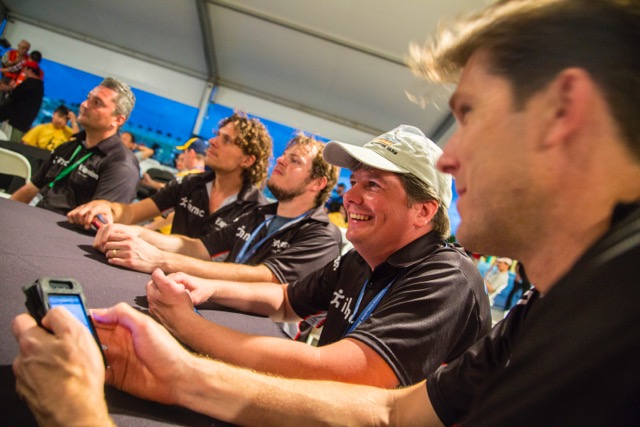
“It’s been a lot of non-stop work, but we’re ready to go,” said Doug Stephen, one of the computer scientists on the project for IHMC.
For years, movies and television shows have portrayed bipedal robots as virtually flawless, fast-moving, self-thinking units. But the reality has lagged far behind that characterization. The DARPA Robotics Challenge was designed to push the science and engineering to the next level. And in recent weeks, IHMC’s Atlas, nicknamed “Running Man,” has stepped up to the occasion, performing well on the tasks it will face in the finals, including driving a car, walking over a debris field, opening doors, cutting a hole in a wall, turning a valve for a fire hose and climbing stairs.
The finals require the robots to think for themselves to a large degree and perform the eight tasks in 60 minutes or less — on battery power, without a safety line, and with limited communications with their handlers. This week, IHMC’s machine finished the practice course well within the time frame.
“I am unconditionally proud of our robotics team and hope that the robot fates smile upon them in Pomona,” said IHMC CEO/Director Ken Ford. “They are a terrific group of young engineers and computer scientists.”
In the first two rounds of the Robotics Challenge in 2013, IHMC placed first in the virtual (computer simulation) trials, and second in the field trials, thanks in large part to the advanced computer software IHMC developed, organizers said. Other teams in next week’s finals come from some of the most advanced robotics programs in the country, including Massachusetts Institute of Technology, Lockheed Martin, and Carnegie Mellon University, as well as several teams from Japan, South Korea, China and Germany.
IHMC robotics staff members are planning to spend most of Thursday and Friday packing Atlas, the Polaris four-wheeled vehicle it will drive, and almost a ton of support and computer equipment for shipment by FedEx to California. The truck and most team members leave Saturday morning.
A video of Wednesday’s final practice run at the IHMC Robotics Lab in Pensacola can be seen here:https://www.youtube.com/watch?v=iCPiNOwh2is. Photos of the Atlas robot and the research team are attached to this email. IHMC also hopes to provide a news release Saturday night, June 6, after the results of the finals are announced.
For more information, contact Will Rabb, IHMC communications coordinator, at 850-512-4327 or email atwrabb@ihmc.us. DARPA updates on the competition can be found at http://www.theroboticschallenge.org.
NASA Asteroid Redirect Mission App
Published 9.10.15
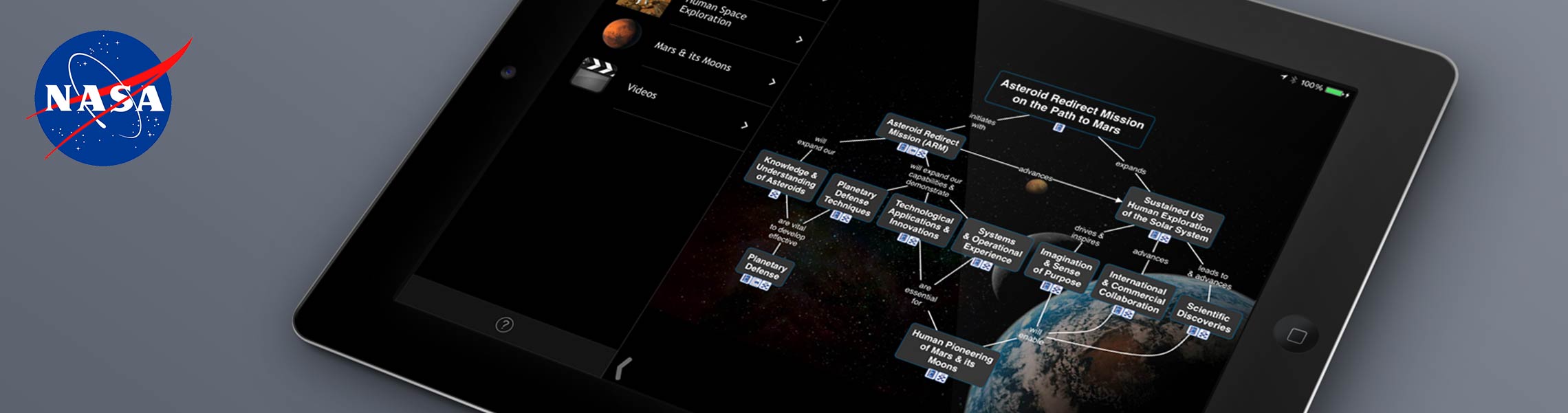
NASA’s Asteroid Redirect Mission iPad App has been released and is available for free download at the iTunes Store. The creation of this novel App was a joint effort between NASA and IHMC. The App is a large knowledge model that uses dozens of concept maps to organize and navigate through hundreds of videos, images and Web links on NASA’s Asteroid Redirect Mission. Each of the concept maps represents the knowledge of experts on the particular topic.
All concept maps in this app were constructed using the IHMC CmapTools software which is available free for download.
Check our web page, download and experience the App, and then go give us a great review. 5 star reviews are warranted and appreciated!
http://cmap.ihmc.us/armapp/
IHMC Moves Ahead with Pensacola Expansion
Published 9.4.15
The Florida Institute for Human and Machine Cognition is back on track with a planned expansion of its Pensacola research facility following a nearly year-long delay caused by flooding of downtown in April 2014.
Completion is scheduled for February 2016. The contractor is Hewes and Company LLC, a Pensacola firm. Hewes has done extensive work across the Pensacola area, including large buildings for Pensacola Christian College, Avalex Technologies and AppRiver.
“We’re really pleased to be back on track with the new building,” said IHMC Director and CEO Ken Ford. “The delay was troublesome, but the architects were able to develop some really good, workable solutions. We’re eager now to get this building built and keep growing in Pensacola.”
In response to the flooding, the first floor of the new building was redesigned to raise it by one foot, to an elevation of 13 feet above sea level, and all structural materials were reviewed to ensure that they are water-resistant. Meanwhile, flood damage to the existing building has been repaired, but a planned expansion of that facility remains on hold.
The three-story, 30,000-square-foot building will substantially increase IHMC’s Pensacola footprint, allowing consolidation of research and administrative functions at the main campus at 40 S. Alcaniz Street in the Seville Historic District, and allow for future growth. IHMC’s operations are currently spread over four separate sites in downtown.
The $8 million expansion is being funded with a loan secured through Escambia County. IHMC is solely responsible for repayment of the loan.
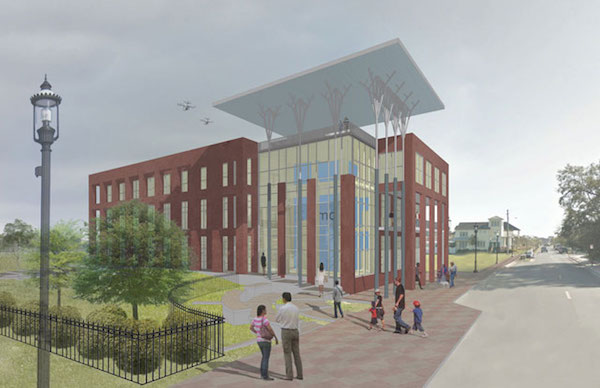
The new building will face Romana Street and be located behind the current facility on land IHMC owns between Alcaniz and Florida Blanca streets. The building’s facade will be reminiscent of the old brick warehouses that used to dominate the area while serving the Port of Pensacola.
Lead architect Carter Quina, AIA, of Quina Grundhoefer Architects in Pensacola, said the appearance of the redesigned building remains virtually the same as before, while providing more security against potential future flooding. It retains its “fit” with the nearby historic neighborhoods.
“We worked hard to give it a look that fits in with the Historic District, and that remains,” Quina said. “The interior is high-tech, but the exterior reflects its location in what the city designated as the Brick Warehouse District, and the use of brick, steel and concrete, all historical materials used in the area, gives it that feel. We’re also adding glass to allow natural daylight inside and to make the interior accessible to the public.”
He said the new building features design and technology that “maintain all of our sustainability goals,” including the extensive use of natural daylight, LED lighting that adjusts to the daylight, extensive soundproofing for the labs, durable materials, and a powerful lab hoist designed with input from the scientists who will be using it.
The building was also designed to foster the use of stairs instead of elevators, cutting energy use and helping employees stay fit.
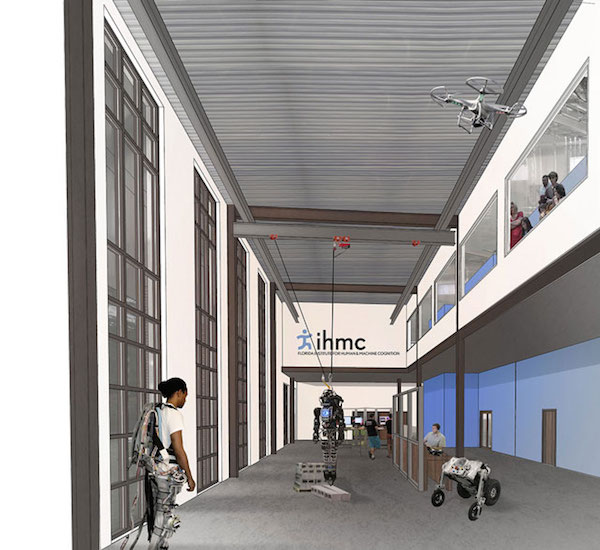
The first floor of the new building will largely consist of research labs, including an expanded Robotics Lab and a multi-sensory interfaces lab focused on sensory displays and human-machine interfaces, and a street-front lobby/exhibit space demonstrating the work at IHMC.
The second floor will feature a glass-walled observation area for public tour groups and others to observe the Robotics Lab safely and without interfering with the work. The lab is a popular tour destination for schools and other visitors.
The third floor will hold additional offices, conference rooms and research space.
Discovery Channel To Feature IHMC Exoskeleton
Published 9.2.15
An upcoming segment of The Discovery Channel’s Daily Planet program will feature a new exercise exoskeleton developed by researchers at the Florida Institute for Human and Machine Cognition (IHMC) in Pensacola.
Called the Grasshopper, or Hopper, the device was designed, built and tested as part of a NASA-funded project exploring the use of robotic exoskeletons for microgravity exercise. Because the Hopper uses motors instead of gravity to create the load on the user, the device is suited for use on space missions. Exercise in zero-gravity conditions is critical to maintain muscle strength and bone mass.
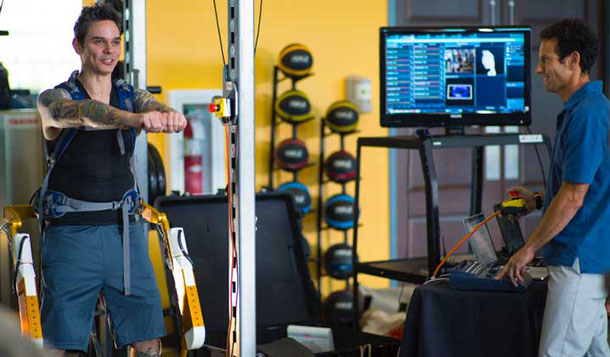
The Hopper is designed to replicate the effect of squat exercise with free weights, and its associated loading on the body. To test this claim, the Hopper was brought to EXOS, a leader in integrated performance training, nutrition and physical therapy for professional and elite athletes, the military and innovative corporations. EXOS has a center in Gulf Breeze, Fla., near IHMC.
The IHMC team is led by Senior Research Scientist Peter Neuhaus. Members include Research Associate Nick Payton and student interns Travis Craig and Jeremy Gines.
Noraxon, a company specializing in evidence-based biomechanics, provided sensors and technical analysis to compare exercise using the Hopper versus use of free weights.
The Daily Planet segment was filmed at IHMC and the EXOS center. The show’s host, Lucas Cochran, was instrumented with the Noraxon sensors and coached by an EXOS specialist on how to properly perform the squat motion, both with free weights and while strapped into the Hopper. The data showed that his muscles and heart responded in very similar fashion while using either the Hopper or the free weights. In addition, Cochran reported that the Hopper was more comfortable than free weights for a similar weight.
The Daily Planet segment will air late October 2014.
For more information about the Hopper go to: http://robots.ihmc.us/grasshopper
To see a video of the Hopper, go to http://youtu.be/Akz5K4BXfAg